




The Gujarat Industries & Mines Department has issued the operational Government Resolution for the MSME Scheme under the Viksit Gujarat Industrial Policy 2026.
The policy period runs from 1 June 2026 to 31 May 2031, while eligible capital investment is considered from 1 January 2026, subject to the detailed conditions of the applicable Government Resolution.
For eligible MSMEs, the core incentive package consists of:
- Capital subsidy
- Interest subsidy
- Power tariff assistance
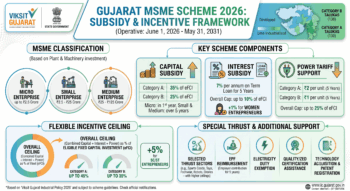
For regular MSMEs, the overall incentive ceiling is 45% of Eligible Fixed Capital Investment (EFCI) in Category-A talukas and 35% in Category-B talukas.
The policy also provides additional assistance covering areas such as ERP, quality certification, ZED certification, ICT and Industry 4.0, technology acquisition, patents, energy and water audits, SME exchange listing, CGTMSE fees, power connection charges, rent and electricity duty.
The key point is simple: eligibility alone is not enough. Correct EFCI calculation, taluka classification, documentation and timely PEC/FEC filing can directly affect the amount an enterprise receives.
 What Is the Gujarat MSME Scheme 2026?
The MSME Scheme forms part of the Viksit Gujarat Industrial Policy 2026, Gujarat’s current industrial incentive framework.
The operational GR converts the broader policy into an implementation framework covering eligibility, investment calculations, incentive ceilings, application procedures, sanctioning authorities and compliance requirements.
For a manufacturing enterprise considering a new project, expansion or eligible investment in Gujarat, the practical questions are:
- Does the enterprise qualify as an MSME?
- Which taluka category applies?
- What investment qualifies as EFCI?
- Which incentive combination is available?
- What application deadlines apply?
- What documentation must be maintained?
These questions should be answered before the project investment and filing strategy are finalised.
MSME Classification Under Gujarat Industrial Policy 2026
The policy uses investment in plant and machinery or equipment as part of the MSME classification framework.
| Enterprise | Investment in Plant & Machinery / Equipment |
|---|---|
| Micro | Up to ₹2.5 crore |
| Small | Above ₹2.5 crore to ₹25 crore |
| Medium | Above ₹25 crore to ₹125 crore |
However, classification and subsidy calculation should not be confused.
GFCI is relevant for classification, while subsidy calculations use Eligible Fixed Capital Investment (EFCI).
That distinction is critical when preparing a subsidy estimate.
What Is EFCI?
Eligible Fixed Capital Investment is the investment base against which many incentives are calculated.
Broadly, eligible items can include:
- New project buildings, subject to applicable limits
- Construction directly connected with the project
- New plant and machinery
- Certain pollution-control and desalination equipment
- Eligible captive DG equipment within the prescribed limit
- Eligible technology and patent expenditure
- A prescribed portion of project infrastructure costs
The following generally do not form part of eligible investment:
- Land
- Working capital
- Second-hand machinery
- Goodwill
- Certain preliminary expenses
- Capitalised interest
- Rented or leased assets
- Certain power-generation assets
Why EFCI Calculation Matters
Suppose a project has a total investment of ₹15 crore.
That does not automatically mean the enterprise has ₹15 crore of EFCI.
Land, working capital and other excluded components can materially reduce the eligible base.
Before applying, a business should therefore prepare a documented EFCI computation supported by invoices, payment records, asset schedules and project documents.
This is one of the areas where professional review can prevent avoidable errors.
The Three Core MSME Incentives
The MSME framework provides three principal incentive components.
1. Capital Subsidy
For regular MSMEs:
Category-A Taluka
- Micro: 35% of EFCI
- Small and Medium: 35% of EFCI
- Small and Medium incentives are disbursed over the prescribed five-year period
- Annual disbursement is subject to the applicable ceiling
Category-B Taluka
- Micro: 25% of EFCI
- Small and Medium: 25% of EFCI
- Small and Medium incentives are disbursed over five years
The capital subsidy is part of the overall incentive framework rather than an amount that should simply be added to every other incentive at its maximum.
2. Interest Subsidy
Eligible enterprises can receive:
7% per annum on the eligible term loan for five years, subject to the applicable EFCI ceiling and scheme conditions.
An additional rate may apply for specified categories such as women entrepreneurs, startups and first-generation entrepreneurs where the relevant provisions are satisfied.
Businesses should calculate the expected benefit using the actual eligible term loan, applicable rate and EFCI ceiling rather than using the headline percentage alone.
3. Power Tariff Assistance
Power assistance is linked to actual electricity consumption.
| Taluka | Assistance |
|---|---|
| Category-A | ₹2 per unit |
| Category-B | ₹1 per unit |
The assistance operates for the prescribed period and remains subject to the applicable EFCI ceiling.
For electricity-intensive manufacturing units, this component can become an important part of the incentive planning exercise.
Overall Incentive Ceiling
The regular MSME framework provides an overall ceiling of:
- 45% of EFCI for Category-A talukas
- 35% of EFCI for Category-B talukas
The three core components can be structured within the applicable overall ceiling.
This is important because businesses should not calculate:
Maximum capital subsidy + maximum interest subsidy + maximum power subsidy = guaranteed total benefit.
Instead, the applicable overall ceiling and individual component ceilings must be considered together.
EPF Reimbursement
The scheme also provides EPF reimbursement for eligible new employees.
The employer’s eligible statutory EPF contribution can be reimbursed subject to employee-level ceilings and scheme conditions.
The source GR provides different monthly ceilings for:
- Male employees
- Female employees
- Specially-abled employees
The reimbursement period is linked to the Date of Commercial Production and can extend for five years for eligible MSMEs.
Businesses should maintain employee records, UAN-related documentation and payroll evidence throughout the claim period.
12 Additional MSME Support Schemes
The Gujarat MSME framework extends beyond capital, interest and power assistance.
Additional support includes:
| Area | Assistance |
|---|---|
| ERP Software | Up to 65% of eligible capital cost |
| Quality Certification | Assistance toward certification/testing |
| ZED Certification | Assistance toward eligible charges |
| ICT / Industry 4.0 / AI | Up to 65% of eligible capital expenditure |
| Technology Acquisition | Up to 65% of eligible cost |
| Patent Registration | Up to 75% of eligible cost |
| Energy / Water Audit | Audit and equipment assistance |
| SME Exchange Listing | Assistance toward eligible fundraising expenditure |
| CGTMSE Fees | Reimbursement of eligible annual service fees |
| Power Connection | 35% of eligible charges, subject to ceiling |
| Rent Subsidy | Assistance for eligible manufacturing premises |
| Electricity Duty | Exemption subject to applicable provisions |
Each additional scheme has its own conditions, ceiling, documentation and application process.
Therefore, receiving the main MSME incentive does not automatically mean every additional benefit is claimed.
Enhanced Benefits for Five Thrust Sectors
The policy identifies five manufacturing sectors for enhanced incentives:
- Sports Goods
- Toys
- Footwear
- Robots
- Drones
For eligible units in these sectors, the incentive ceiling can rise to:
- 50% of EFCI in Category-A talukas
- 45% of EFCI in Category-B talukas
The enhanced framework also changes the applicable component ceilings.
Businesses should verify their exact NIC/activity classification before assuming that their product qualifies as a thrust-sector activity.
A seemingly small difference in classification can affect the applicable incentive structure.
Additional Benefits for Thrust-Sector MSMEs
Eligible thrust-sector enterprises may also access additional benefits covering areas such as:
- Stamp duty and registration charges
- Intellectual property registration
- Technology acquisition
- International certification
- Manpower training
- Creative design studios
- AI subscriptions for eligible micro enterprises and artisans
For exporters and manufacturers requiring international certifications, the certification-related assistance can be particularly relevant.
The exact eligibility, expenditure date and application deadline should be checked against the applicable GR before committing expenditure.
PEC and FEC: The Two Critical Certificates
One of the most important practical aspects of the scheme is understanding the difference between Provisional Eligibility Certificate (PEC) and Final Eligibility Certificate (FEC).
Stage 1: PEC
The PEC establishes provisional eligibility based on the eligible investment assessed at the relevant stage.
The application timeline is linked to the Date of Commercial Production and the operative GR date, with the applicable “later of” rule determining the deadline for existing cases.
For enterprises covered by the 25 September 2026 GR, businesses should calendar the applicable deadline rather than assuming that the policy announcement date alone determines the filing date.
Stage 2: FEC
The Final Eligibility Certificate is connected to completion of the eligible investment period.
For eligible investment:
- Projects up to ₹50 crore of GFCI generally have a 12-month investment period.
- Projects from ₹50 crore to ₹125 crore generally have an 18-month investment period.
The FEC application must then be filed within the prescribed period.
Why FEC Deadlines Matter
The GR provides consequences for delayed filing and does not allow an application indefinitely.
A business should therefore create a compliance calendar on the date of commercial production and track:
- DoCP
- Eligible investment period
- PEC deadline
- Investment completion date
- FEC deadline
- Annual reimbursement requirements
Who Sanctions the Incentives?
The applicable authority depends on enterprise size and the particular incentive.
For core MSME incentives, the broad structure is:
| Enterprise | Primary Authority |
|---|---|
| Micro | General Manager, DIC |
| Small | General Manager, DIC |
| Medium | MSME Commissioner |
Some additional schemes are handled by different authorities.
This is another reason not to treat the entire incentive framework as a single application.
Compliance Conditions Every MSME Should Understand
Receiving an incentive creates ongoing compliance obligations.
Important requirements include:
Employment
The scheme contains local employment requirements, including:
- 85% of total employees from Gujarat domicile
- 60% of managerial and supervisory employees from Gujarat domicile
These requirements can be checked during the eligibility and reimbursement stages.
Environmental Compliance
Where applicable, the enterprise must maintain the required Gujarat Pollution Control Board documentation.
Continuous Production
The enterprise is expected to remain in commercial production during the applicable incentive period, subject to provisions dealing with genuine temporary stoppages.
Other State Incentives
An enterprise generally cannot simultaneously claim another State Government incentive for the same eligible benefit where the GR prohibits such double claiming.
Total Government Incentives
The total State and Central Government incentives remain subject to the applicable overall limits.
8-Step Gujarat MSME Subsidy Action Checklist
Step 1: Identify Your Taluka Category
Determine whether the project location falls under Category-A or Category-B.
Step 2: Confirm Your Sector
Check whether your manufacturing activity falls within one of the enhanced thrust sectors.
Step 3: Calculate EFCI
Prepare a detailed eligible-investment schedule and remove excluded costs.
Step 4: Confirm Your DoCP
The Date of Commercial Production is central to several eligibility and deadline calculations.
Step 5: Prepare the PEC
Prepare the application, supporting documents and investment evidence within the applicable window.
Step 6: Track Eligible Investment
Maintain an asset-wise record of invoices, payments, installation and commissioning.
Step 7: Prepare the FEC
Do not wait until the end of the deadline period. Start FEC preparation as soon as the eligible investment period approaches completion.
Step 8: Maintain Annual Compliance
Keep employment, production, environmental, banking and reimbursement records organised throughout the incentive period.
What Should an MSME Do Before Investing?
The most effective subsidy planning happens before expenditure is committed.
Before purchasing major machinery or finalising project financing, evaluate:
- Enterprise classification
- Taluka category
- NIC/activity classification
- Eligible project cost
- EFCI
- Term loan structure
- Expected electricity consumption
- Applicable capital subsidy
- Interest subsidy
- Power tariff benefit
- Additional schemes
- Thrust-sector eligibility
- Application deadlines
This converts subsidy planning from a post-investment paperwork exercise into a project-finance decision.
Frequently Asked Questions
Can a Gujarat MSME claim capital, interest and power subsidies together?
Yes, the framework allows eligible MSMEs to combine the three core components subject to the applicable individual and overall EFCI ceilings.
What is EFCI in Gujarat MSME subsidy?
EFCI means Eligible Fixed Capital Investment. It is the eligible investment base used for calculating several incentives and excludes specified items such as land and working capital.
What is the maximum regular MSME incentive in Gujarat?
The overall ceiling for regular MSMEs is generally 45% of EFCI in Category-A talukas and 35% in Category-B talukas, subject to the applicable scheme conditions.
Which sectors receive enhanced incentives?
Sports goods, toys, footwear, robots and drones are identified as selected thrust sectors for enhanced incentives.
Can Central and Gujarat Government MSME benefits be claimed together?
The framework permits Central and State benefits subject to the applicable overall limits and conditions. Another State Government incentive may not be simultaneously claimable where the policy prohibits such overlap.
Does rent subsidy apply to an office?
No. The relevant rent assistance is linked to eligible manufacturing premises and does not automatically apply to ordinary office space.
What happens if an MSME misses its FEC deadline?
Late filing can result in reduction of the applicable incentive and the GR places a hard outer limit on FEC applications. Businesses should therefore track the deadline from the investment-period completion date.
Should an MSME calculate subsidy before buying machinery?
Yes. Subsidy planning should ideally happen before major investment decisions because eligibility, EFCI treatment, financing structure and documentation can affect the eventual benefit.
How Mistry & Shah Can Help With Gujarat MSME Subsidies
Government incentives can look straightforward on paper, but the practical process involves investment classification, EFCI computation, eligibility certificates, supporting documents, deadlines and ongoing compliance.
Mistry & Shah LLP provides industrial subsidy advisory services covering:
- EFCI computation and verification
- MSME subsidy eligibility assessment
- PEC and FEC preparation
- Government application filing
- Follow-up with relevant authorities
- Additional scheme applications
- CGTMSE and certification-related benefits
- Thrust-sector incentive assessment
- Annual compliance review
- Comparison of applicable policy options
For a manufacturing enterprise planning investment in Gujarat, the right time to evaluate the subsidy is before the investment is fully committed.
Mistry & Shah LLP
Chartered Accountants — Ahmedabad, Gujarat
Email: ketan@mistryandshah.com
WhatsApp: +91 94260 49084
Website: mistryandshah.com
Location: Ahmedabad, Gujarat
Conclusion
The Gujarat MSME Scheme under the Viksit Gujarat Industrial Policy 2026 creates a structured incentive framework covering capital investment, financing costs, electricity consumption, employment and several technology and business-development expenses.
But the headline subsidy percentage is only the starting point.
The actual benefit depends on the enterprise category, taluka, eligible investment, financing structure, sector classification, applicable ceilings and compliance with the prescribed application timelines.
For MSMEs investing in Gujarat in 2026 and beyond, the practical approach is to identify eligibility first, calculate EFCI correctly, plan the incentive mix, document every eligible expenditure and calendar the PEC/FEC deadlines from the beginning.
Disclaimer: This article is for general information and awareness. Eligibility, incentive quantum, application procedure and deadlines are subject to the applicable Government Resolutions, subsequent amendments or clarifications and the specific facts of each enterprise. Businesses should obtain professional advice before relying on the information for an investment or subsidy claim.
By: Mistry & Shah LLP, Chartered Accountants — Ahmedabad, Gujarat
© 2026 Mistry & Shah LLP. All rights reserved.