




FOR DETAILED OPERATIONAL PROVISIONS(GR) ON MSME: FOLLOW BELOW LINK:
https://www.mistryandshah.com/gujarat-msme-scheme-2026/
Gujarat has long been India’s industrial powerhouse. With a GSDP of USD 329.7 billion in 2024-25; a 20-fold rise over 22 years; and handling roughly 40% of India’s port cargo, the state has earned its reputation as the country’s preferred manufacturing and export destination. Now, the Government of Gujarat has raised the bar further with the Viksit Gujarat Industrial Policy 2026, a five-year framework effective from 1 June 2026 that offers unprecedented subsidies and incentives to qualifying industries.
This is not merely an extension of previous policies. It signals a deliberate structural shift: away from low-margin, volume-driven activity and toward high-value, technology-intensive manufacturing. For business owners, the opportunity is significant; but navigating the subsidy framework correctly requires expert guidance.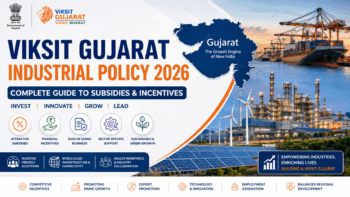
This article distils what matters most for business owners, manufacturers, and entrepreneurs planning investments over the next five years.
For More detailed Presentation or to check your eligibity, Contact us at:
Contact us today: ketan@mistryandshah.com
Whats App: +919426049084 https://wa.me\9426049084
What Is the Viksit Gujarat Industrial Policy 2026?
The Gujarat Industrial Policy 2026 (officially “Viksit Gujarat Industrial Policy 2026”) is the state government’s flagship five-year industrial incentive framework, valid from 1 June 2026. Its stated vision “Viksit Gujarat se Viksit Bharat @2047″ targets a state economy of approximately USD 3.5 trillion by 2047, growing at 14–15% CAGR through 2030.
The policy focuses on eight mission pillars:
- advanced manufacturing,
- global value chain integration,
- export promotion,
- future-ready industrial parks,
- single-window approvals (“Udyog Sahay Kendra”),
- R&D and industry-academia linkages,
- skilled workforce development, and
- services sector acceleration.
For business owners, the signal is clear; the government wants high-quality, large-scale, technology-driven projects; and the subsidy structure rewards exactly that.
21+ Thrust Sectors: Does Your Business Qualify for Enhanced Subsidies?
The first; and most consequential; question under the Gujarat Industrial Policy 2026 is whether your activity falls within a recognised thrust sector.
Thrust-sector classification can raise your subsidy ceiling by 10 to 20 percentage points over a general-sector unit. This is precisely why engaging a top industrial subsidy consultant early in project planning is critical.
The policy identifies 21+ thrust sectors, including:
- Green Energy Ecosystem (green hydrogen, electrolysers, RE equipment, battery storage, fuel cells)
- Mobility (auto components, aviation and space manufacturing)
- Capital & Industrial Equipment (electrical, industrial and telecom machinery)
- Textiles & Apparels, including technical textiles
- Metals, Minerals & Ceramics (critical mineral processing and refining)
- Chemicals across the value chain
- Healthcare (bulk drugs, APIs, KSMs, medical devices, pharmaceuticals)
- Semiconductor Ancillary (ultra-high-purity chemicals and gases)
- Nuclear Power Equipment including Small Modular Reactors
- Sustainability Equipment (waste recycling machinery)
- Agro & Food Processing
- Shipping Container Manufacturing, Heavy Earth-Moving Equipment
Five sectors carry special enhanced incentives; the highest subsidy ceilings in the entire policy:
- Sports Goods & Equipment,
- Toys,
- Footwear,
- Robots, and
- Drones
Key advisory: Before filing for any incentive under the Gujarat Industrial Policy 2026, your subsidy consultant should formally confirm your NIC code maps to a recognised thrust sector. This single classification step can materially change the financial outcome of your project.
How the Gujarat Subsidy Framework Works: The Three-Component Mix
Gujarat’s incentive structure under the 2026 policy is built on three components that eligible units can combine in any proportion, up to an overall ceiling:
| Component | What It Covers |
| Capital Subsidy | A percentage of Eligible Fixed Capital Investment (eFCI), disbursed over 5–12 years |
| Interest Subsidy | Up to 7% per annum on term loans, capped as a percentage of eFCI |
| Power Tariff Support | INR 1–2 per unit of electricity consumed, capped as a percentage of eFCI |
The flexibility to choose your own mix is significant. A capital-intensive project with thin margins may benefit more from capital subsidy, while an energy-intensive unit may find power tariff support more valuable. Modelling the optimal combination against your project’s cash flows is exactly the kind of work a best subsidy consultant in Gujarat performs before project registration.
Geography matters too. The policy distinguishes between:
- Category A talukas (less-developed regions, higher subsidy ceilings) and
- Category B talukas (relatively developed regions, standard ceilings).
The same project in a Category A taluka can attract a subsidy ceiling 10 percentage points higher than in Category B. Under the Gujarat Industrial Policy 2026, site selection is therefore a subsidy decision, not just an operational one.
Full district-wise Category A / Category B taluka list (Taluka Category)
The table below is compiled from Annexure-A of GR No. IMD/HMR/e-file/9/2026/2211/I dated 08.09.2026.
Sr. | District | Category A Talukas | Category B Talukas |
1 | Ahmedabad | Dholera, Detroj-Rampura, Dhandhuka | Viramgam, Daskroi, Bavla, Dholka, Sanand, Mandal, Ahmedabad City |
2 | Amreli | Khambha, Dhari, Lilia, Savar Kundla, Babra, Kunkavav Vadia, Lathi | Jafrabad, Rajula, Bagasara, Amreli |
3 | Anand | Tarapur, Anklav, Sojitra | Anand, Umreth, Khambhat, Petlad, Borsad |
4 | Arvalli | Dhansura, Malpur | Meghraj, Bayad, Bhiloda, Modasa, Shamalaji (Bhiloda), Sathamba (Bayad) |
5 | Banas Kantha | Amirgadh, Danta, Dhanera, Kankrej, Vadgam, Dantiwada, Hadad (Danta), Ogad (Kankrej) | Deesa, Palanpur |
6 | Bharuch | Netrang | Bharuch, Jhagadia, Vagra, Anklesvar, Hansot, Valia, Jambusar, Amod |
7 | Bhavnagar | Jesar, Umrala, Vallabhipur, Gariadhar, Palitana, Talaja, Ghogha | Bhavnagar, Mahuva, Sihor |
8 | Botad | Ranpur, Gadhada, Barwala, Botad | — |
9 | Chhota Udepur | Chhota Udepur, Kavant, Nasvadi, Sankheda, Bodeli, Jetpur Pavi, Kadval (Jetpur Pavi) | — |
10 | Devbhumi Dwarka | Kalyanpur, Bhanvad | Khambhalia, Okhamandal |
11 | Dahod | Dhanpur, Sanjeli, Limkheda, Dahod, Fatepura, Jhalod, Singvad, Garbada, Devgadbaria, Sukhasar (Fatepura), Guru Govind Limbdi (Jhalod) | — |
12 | Gandhinagar | — | Kalol, Dehgam, Gandhinagar, Mansa |
13 | Gir Somnath | Gir Gadhada, Talala | Una, Kodinar, Sutrapada, Veraval |
14 | Jamnagar | Jodiya | Lalpur, Jamnagar, Jamjodhpur, Kalavad, Dhrol |
15 | Junagadh | Bhesan, Mendarda | Junagadh, Junagadh City, Visavadar, Malia Hatina, Mangrol, Vanthali, Manavadar, Keshod |
16 | Kachchh | Rapar, Nakhatrana, Lakhpat, Mandvi | Mundra, Anjar, Gandhidham, Abdasa, Bhachau, Bhuj |
17 | Kheda | Galteshwar, Matar, Vaso, Mahudha | Kheda, Nadiad, Mehmedabad, Kathlal, Thasra, Kapadvanj, Fagvel (Kathlal & Kapadvanj) |
18 | Mehsana | Satlasana, Jotana, Kheralu, Becharaji, Vadnagar | Kadi, Mehsana, Unjha, Vijapur, Visnagar |
19 | Mahisagar | Khanpur, Kadana, Virpur | Lunawada, Balasinor, Santrampur, Godhar (Santrampur & Shehra), Kothamba (Lunawada) |
20 | Morbi | Maliya | Wankaner, Morbi, Tankara, Halvad |
21 | Narmada | Garudeshwar, Dediapada, Tilakwada, Sagbara, Chikda (Dediapada) | Nandod |
22 | Navsari | Khergam | Navsari, Bansda, Chikhli, Jalalpore, Gandevi |
23 | Panch Mahals | Ghoghamba, Morwa (Hadaf), Jambughoda, Shehera | Halol, Kalol, Godhra |
24 | Patan | Sarasvati, Santalpur, Shankheshwar, Sami, Radhanpur, Harij | Sidhpur, Chanasma, Patan |
25 | Porbandar | Kutiyana | Porbandar, Ranavav |
26 | Rajkot | Vinchhiya, Jamkandorna | Paddhari, Lodhika, Rajkot, Kotda Sangani, Jasdan, Upleta, Dhoraji, Jetpur, Gondal |
27 | Sabar Kantha | Poshina, Vijaynagar, Khedbrahma | Talod, Vadali, Idar, Prantij, Himatnagar |
28 | Surat | Umarpada, Mahuva, Ambika (Mahuva) | Mangrol, Kamrej, Palsana, Chorasi, Olpad, Surat City, Mandvi, Bardoli, Areth (Mandvi) |
29 | Surendranagar | Lakhtar, Chuda, Muli, Sayla, Limbdi, Dasada, Chotila | Wadhwan, Thangadh, Dhrangadhra |
30 | Tapi | Kukarmunda, Uchchhal, Nizar, Dolvan, Songadh, Ukai (Songadh) | Vyara, Valod |
31 | The Dangs | Subir, Waghai, Aahva | — |
32 | Vadodara | Sinor, Desar | Vaghodia, Karjan, Padra, Savli, Vadodara, Dabhoi |
33 | Valsad | Kaprada, Dharampur, Nanapodha (Kaprada, Vapi, Pardi) | Valsad, Pardi, Vapi, Umbergaon |
34 | Vav-Tharad (new district, ex-Banas Kantha) | Lakhani, Suigam, Vav, Tharad, Deodar, Dharnidhar (Vav), Rah (Tharad) | Bhabhar |
MSME Subsidies Under Gujarat Industrial Policy 2026
MSMEs — defined as units with plant and machinery up to INR 125 crore — receive some of the most accessible subsidies in the policy. Here is a summary of what is available:
| Taluka | Capital Subsidy | Interest Subsidy | Power Tariff Support | Max Subsidy Ceiling |
| Category B | 25% of eFCI (Micro: 1 yr; Small & Medium: 5 yrs) | 7% p.a., 5 yrs (≤10% eFCI) | INR 1/unit, 5 yrs (≤25% eFCI) | 35% of eFCI |
| Category A | 35% of eFCI (same periods) | 7% p.a., 5 yrs (≤10% eFCI) | INR 2/unit, 5 yrs (≤25% eFCI) | 45% of eFCI |
Beyond the core mix, MSMEs also receive targeted support for quality certification (including ZED), technology and ICT adoption, patent registration, energy and water savings, capital market access (SME exchange listing), and market development for exhibitions.
An inclusive provision worth noting: SC entrepreneurs under the Dr. Babasaheb Ambedkar Scheme and ST entrepreneurs under the Bhagwan Birsa Munda Scheme receive an additional 5% subsidy over and above the overall ceiling. Enhanced benefits are also available for entrepreneurs with disabilities.
Industrial Subsidies for Large, Mega and Ultra-Mega Units
For larger investments, the Gujarat Industrial Policy 2026 creates three tiers with progressively richer subsidies and longer disbursement windows:
Large Unit: Minimum INR 125 crore in plant and machinery.
Mega Unit: INR 1,000 crore investment + 250 jobs + thrust sector (every additional INR 200 crore adds 50 jobs to the threshold).
Ultra-Mega Unit: INR 10,000 crore investment + 3,000 jobs + thrust sector (every additional INR 5,000 crore adds 500 jobs).
| Unit Type | Taluka | Capital Subsidy | Max Subsidy Ceiling | Disbursement Period |
| Large — Thrust Sector | Cat. A | 25% of eFCI | 35% of eFCI | 8 years |
| Large — General Sector | Cat. A | 15% of eFCI | 20% of eFCI | 10 years |
| Mega | Cat. A | 25% of eFCI | 35% of eFCI | 10 years |
| Ultra-Mega | Cat. A | 30% of eFCI | 40% of eFCI | 12 years |
The longer disbursement windows; up to 12 years for Ultra-Mega units; provide meaningful cash-flow support across the full investment and ramp-up lifecycle. For projects of this scale, the industrial subsidy is not just a financial benefit; it is a factor in financial structuring. A top industrial subsidy consultant can help model the disbursement schedule into your project finance plan.
Special Provisions: Up to 50% Subsidy for Five Priority Sectors
The most generous subsidies under the Gujarat Industrial Policy 2026 are reserved for five sectors: Sports Goods & Equipment, Toys, Footwear, Robots, and Drones. These sectors; applicable to MSME, Large, Mega, and Ultra-Mega units alike; carry ceilings of:
- Category B talukas: 45% of eFCI
- Category A talukas: 50% of eFCI
These ceilings sit on top of EPF reimbursement, electricity duty exemption, and (for Ultra-Mega units) stamp duty relief. If your business falls in any of these five sectors, the financial case for investing in Gujarat under the 2026 policy is exceptionally strong.
Common Benefits That Stack on Top: EPF, Electricity Duty and Stamp Duty
Every eligible unit under the Gujarat Industrial Policy 2026; regardless of size; can stack the following additional benefits on top of the core subsidy mix:
EPF Reimbursement: 100% reimbursement of the employer’s statutory EPF contribution for 5 years (MSMEs), 8 years (Large — Thrust) or 10 years (Large — General, Mega and Ultra-Mega). Per-employee caps are INR 1,800/month (male), INR 2,500/month (female), and INR 3,000/month (specially-abled).
Electricity Duty Exemption: 100% exemption under the Gujarat Electricity Duty Act, 1958, for the same duration periods as above.
Stamp Duty and Registration Fee Reimbursement: 100% reimbursement available to Ultra-Mega units.
These are not trivial numbers for a large manufacturing unit. EPF reimbursement alone can amount to several crores over the disbursement period for a labour-intensive facility. An experienced industrial subsidy consultant in Gujarat will ensure these benefits are claimed systematically alongside the core incentive application.
Startups, R&D Centres and Women Entrepreneurs
The Gujarat Industrial Policy 2026 is not limited to established manufacturers. Startups receive sustenance allowances of INR 25,000–30,000 per month (higher with a woman co-founder), seed support up to INR 50 lakh, additional interest subsidy up to 9%, and cross-border innovation grants up to INR 1 crore under programmes like the India-Israel Innovation Bridge.
R&D Centres attract a two-tier subsidy structure: the first five centres investing at least INR 300 crore receive 50% capital subsidy up to INR 50 crore per annum for five years, plus land cost reimbursement, power tariff support, and a payroll subsidy of INR 10,000 per person per month for three years. Other centres investing at least INR 100 crore receive 25% capital subsidy.
Women entrepreneurs receive an additional 1% interest subsidy and rental assistance of 75% of rent up to INR 3 lakh per annum for five years. The policy also establishes a Women’s Industrial Leadership Committee (WILC) and a “Return-to-Industry Accelerator” for women rejoining work after a career break.
Environmental Subsidies: Sustainability Is Rewarded
For businesses investing in cleaner production, the Gujarat Industrial Policy 2026 provides direct financial support: up to 50% of project cost for wastewater recycling (MSMEs), Zero Liquid Discharge systems, cleaner production technologies, and common boiler projects. Large and Mega units have proportionately scaled support with higher absolute caps. Green GIDC Estates; clusters powered nearly 100% by renewables with ZLD infrastructure; are being developed to enable green-certified production at scale.
Ease of Doing Business Under Gujarat Industrial Policy 2026
A policy is only as effective as its delivery mechanism. Gujarat has made significant strides here. The Investor Facilitation Portal now covers 200+ approvals across 18 departments, linked to the National Single Window System (NSWS). The Jan Vishwas Act 2025 has decriminalised 731+ provisions and streamlined 3,226 compliances. Incentive disbursals have reportedly increased by 75% in two years.
Project T.H.R.I.V.E (Transition for Harmonized Relocation and Inclusive Vibrant Economy) provides a structured pathway for units relocating from congested city limits to planned industrial estates, with relaxations on transfer fees, FSI benefits, and facilitated environmental clearances.
How to Maximise Your Industrial Subsidy Under Gujarat Industrial Policy 2026: Six Steps
If you are an industrialist, manufacturer or entrepreneur assessing the Gujarat Industrial Policy 2026, here is your action checklist:
- Confirm your thrust sector status. Sector classification under the Gujarat Industrial Policy 2026 is the single biggest lever determining your subsidy ceiling. Get a formal determination from a qualified subsidy consultant before finalising project financials.
- Model your subsidy mix. Compare the three combinations — capital, interest, power — against your projected cash flows and the applicable ceiling. The optimal mix varies by project type. This is where a top industrial subsidy consultant adds the most value.
- Choose your location deliberately. Category A talukas offer materially higher subsidy ceilings under the Gujarat Industrial Policy 2026. Site selection is a subsidy decision, not just a logistics one.
- Stack the common benefits. Layer EPF reimbursement and electricity duty exemption on top of your core subsidy mix. Ultra-Mega units should additionally capture stamp duty reimbursement.
- Move early. The Gujarat Industrial Policy 2026 runs for five years from 1 June 2026. Projects registered in year one benefit from longer disbursement windows. Early movers also access the R&D early-bird incentives.
- Verify against the official GRs. This article is a summary. Final eligibility criteria, quantum of subsidies, and procedural requirements under the Gujarat Industrial Policy 2026 are governed by the Government Resolutions (GRs) issued by the Industries & Mines Department. Engaging the best subsidy consultant in Gujarat to map your specific project against the GRs is essential before committing to a plan.
Why Choose Us | Best Subsidy Consultant in Gujarat
Mistry & Shah is a Chartered Accountancy firm that specialises in industrial subsidy advisory for Gujarat-based manufacturers, MSMEs, and large industrial groups. As a top industrial subsidy consultant with deep expertise in Gujarat Industrial Policy frameworks, we assist clients at every stage:
- Eligibility Assessment — Sector classification, NIC code mapping, eFCI computation
- Subsidy Mix Modelling — Optimising the capital, interest, and power tariff combination for your project’s cash flows
- Application Filing — End-to-end support on the Investor Facilitation Portal and Udyog Sahay Kendra
- Disbursement Tracking — Ongoing compliance, claim filing, and government liaison through the full disbursement period
- Ancillary Incentives — EPF reimbursement, electricity duty exemption, stamp duty relief, ZED certification, and more
Whether you are evaluating a new greenfield project, expanding an existing facility, or exploring the Gujarat Industrial Policy 2026 for the first time, our team can help you build and execute an incentive strategy that maximises your entitlement.
Contact us today: ketan@mistryandshah.com
Whats App: +919426049084 https://wa.me\9426049084
Frequently Asked Questions — Gujarat Industrial Policy 2026
Q: What is the maximum subsidy available under Gujarat Industrial Policy 2026?
A: Up to 50% of eFCI for units in the five special-provision sectors (Toys, Sports Goods, Footwear, Robots, Drones) in Category A talukas. For other thrust sectors, the ceiling is 35–45% depending on unit size and location.
Q: Who can apply for industrial subsidies under the Gujarat Industrial Policy 2026?
A: New and expansion industrial units registered in Gujarat after 1 June 2026 that meet the investment and employment thresholds for their size category (MSME, Large, Mega or Ultra-Mega).
Q: How long does the subsidy disbursement last?
A: 5 years for MSMEs, 8–10 years for Large units, 10 years for Mega, and up to 12 years for Ultra-Mega units — from the date of commencement of commercial production.
Q: Do I need a consultant to apply for subsidies under Gujarat Industrial Policy 2026?
A: Technically, no — but practically, yes. The subsidy framework has multiple components, eligibility conditions, government resolution cross-references, and portal procedures. Errors at the application stage can result in delayed or reduced disbursals. Engaging a best subsidy consultant in Gujarat ensures your application is complete, accurate, and optimised from the outset.
Q: Can MSMEs avail both capital subsidy and interest subsidy simultaneously?
A: Yes. The three components — capital subsidy, interest subsidy, and power tariff support — can be combined in any proportion up to the overall eFCI ceiling applicable to your unit type and taluka category.
Disclaimer: This article summarises key provisions of the Viksit Gujarat Industrial Policy 2026 for general awareness. It is not a substitute for the official Government Resolutions (GRs) or for specific professional advice. Eligibility and quantum of subsidies are subject to the terms of the relevant GRs and any amendments thereto. Mistry & Shah is a Chartered Accountancy firm; this article constitutes general information, not legal or financial advice.
For More detailed Presentation or to check your eligibity, Contact us at:
Interested
Please contact for furtehr detaila on 9426049084
I need to start textile garmnets wash innovation projects
In Surat
Shall I get financial approvals
Pls contact me on 6364035805
Thanks
Prahlad
Yes you can get the benifit under Vikshit Gujarat Industrial policy 2026. Please contact for furtehr detaila on 9426049084
Furnishing bizness karna he kya kare
Please contact for furtehr detaila on 9426049084
Good to know the important details and information regarding this new “Viksit Gujarat Industrial Policy 2026”
Thank you. Any plan to Invest in Gujarat?
Kindly share details
TALUKA SPECIFICALLY OLPAD, KIM, SURAT AND BARDOLI CATEGORISED AS “A” OR “B”.
It is not yet Specified. Please share you number, we will keep you updated once it is decleared
HELLO SIR. WE ENGAGED WITH THE MANUFACTURING CHEMICAL VAPOUR DIAMOND . SAY CVD DIAMOND . WE WANT EXPAND OUR UNIT . COST 2.5 CRORE MEANS 25 MILLION. PL GIVE ADVICE CAN I GET OR TAKE ASSISTANT OF THIS BENEFIT OF 2026 INDUSTRIAL POLICY. MY FIRM NAME IS VINAYAK LGD LLP. SURAT
Yes you can get the benifit under Vikshit Gujarat Industrial policy 2026. Please contact for furtehr detaila on 9426049084
Good compilation of new Gujarat Industrial Policy.
Thank you
Hi, I need some information regarding government subsidies for setting up a new resin manufacturing factory in Gujarat under the “Viksit Bharat / Viksit Gujarat” industrial policies.
Currently, I am based in Mumbai, and I am planning to establish a new resin manufacturing unit in Gujarat. My business falls under the Micro Industry category.
I would like to understand the following:
1. Can you share the list of Category A and Category B locations/areas in Gujarat where new industries can be set up?
2. Which locations would be suitable for a resin manufacturing unit?
3. Am I eligible for government subsidy/incentives under the current policy as a Micro Industry?
4. What types of subsidies or benefits can I avail (capital subsidy, interest subsidy, electricity duty exemption, stamp duty benefits, etc.)?
Please guide me on the best suitable location and subsidy eligibility for my project.
Dear Hiteshbhai, yes you can get the incentives from Gujarat Govt under new Vikshit Gujarat Industrial Policy 2026, for more details please contact us on 9426049084.
When is the gr of policy is coming still I am not able to see any policy on official website.
Dear Prerak,
It is still under process. will keep you posted once it is announced.
I have a regd startup in gujarat working in AI. can i get releavnt benefirts under this policy
Hello Nitesh,
you can get the benifit under Gujarat IT/ITES policy. Please contact on +919426049084 for more details.