




TL;DR
Indian export businesses operate under a GST framework that treats exports as “zero-rated supplies,” allowing exporters to claim refunds on taxes paid. However, many businesses face delayed refunds, ITC mismatches, compliance notices, and working capital issues due to poor documentation and filing errors.
This guide explains:
- GST rules for exporters
- LUT vs IGST options
- Refund optimization strategies
- Export compliance best practices
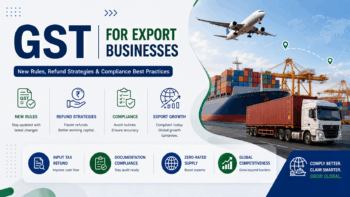
- Common mistakes that delay refunds
- Practical ways to stay audit-ready
Why GST Compliance Matters for Export Businesses
For exporters, GST compliance is not just a tax obligation — it directly affects:
- Cash flow
- Working capital
- Investor confidence
- International trade efficiency
- Profit margins
A delayed GST refund can block lakhs or even crores of rupees in working capital.
According to industry estimates, many SMEs lose significant operational liquidity because:
- Refund applications contain mismatches
- Shipping documentation is incomplete
- GSTR filings are inconsistent
- ITC reconciliation is weak
Export businesses scaling internationally need strong GST systems from day one.
At MISTRY & SHAH LLP, GST advisory and compliance services are designed to help exporters streamline regulatory obligations while reducing operational risk.
Understanding Zero-Rated Supplies Under GST
Exports are classified as zero-rated supplies under GST.
This means:
- GST is technically applicable
- But the effective tax burden is zero
- Exporters can claim refunds on taxes paid on inputs
Zero-Rated Supplies Include:
| Transaction Type | GST Treatment |
|---|---|
| Export of goods | Zero-rated |
| Export of services | Zero-rated |
| Supplies to SEZ | Zero-rated |
This mechanism ensures Indian exports remain globally competitive.
Export of Goods vs Export of Services
Many businesses misunderstand the distinction.
| Criteria | Export of Goods | Export of Services |
|---|---|---|
| Physical movement | Required | Not required |
| Foreign exchange receipt | Required | Required |
| Shipping bill | Mandatory | Not applicable |
| Place of supply | Outside India | Outside India |
| GST treatment | Zero-rated | Zero-rated |
Export of Services Conditions
To qualify as export of services:
- Supplier must be in India
- Recipient must be outside India
- Payment received in convertible foreign exchange
- Place of supply outside India
This is especially important for:
- SaaS companies
- IT service firms
- Consulting businesses
- Offshore accounting providers
LUT vs Paying IGST: Which Option Is Better?
Exporters generally choose between:
Option 1: Export Under LUT
- No upfront GST payment
- File Letter of Undertaking (LUT)
- Most preferred option
Option 2: Pay IGST & Claim Refund
- GST paid initially
- Refund claimed later
- Impacts working capital
Which Is Better?
| Factor | LUT | IGST Payment |
|---|---|---|
| Working capital impact | Low | High |
| Refund dependency | Lower | Higher |
| Cash flow efficiency | Better | Slower |
| Popularity among exporters | Very High | Moderate |
For most SMEs, LUT is operationally more efficient.
GST Refund Process for Exporters
Step-by-Step Refund Workflow
Step 1: File GST Returns Correctly
Ensure:
- GSTR-1
- GSTR-3B
- Shipping details
- Invoice data
all match accurately.
Step 2: Maintain Export Documentation
Required documents may include:
- Shipping bills
- LUT copy
- Invoices
- Foreign inward remittance certificates
- Bank realization certificates
Step 3: File Refund Application
Use Form:
- RFD-01
Step 4: GST Officer Verification
Authorities verify:
- Invoice consistency
- ITC claims
- Export documentation
Step 5: Refund Credit
Approved refund gets credited to the registered bank account.
Common Reasons GST Refunds Get Delayed
Refund delays usually happen because of operational mistakes rather than legal complexity.
Major Causes Include:
- GSTR-1 and GSTR-3B mismatch
- Wrong invoice numbers
- Missing shipping bills
- Invalid LUT
- Incorrect HSN/SAC classification
- ITC reconciliation gaps
- Vendor non-compliance
Operational Impact
Delayed refunds create:
- Working capital stress
- Vendor payment delays
- Export order disruption
- Cash flow bottlenecks
Essential GST Compliance Checklist for Export Businesses
Monthly Compliance Checklist
| Compliance Area | Action Required |
|---|---|
| GSTR-1 filing | Verify invoice accuracy |
| GSTR-3B filing | Match liability properly |
| ITC reconciliation | Compare books with GSTR-2B |
| LUT validity | Renew annually |
| Export invoices | Maintain proper format |
| Foreign remittance proof | Preserve documentation |
| Vendor compliance | Monitor filing status |
Input Tax Credit (ITC) Best Practices
ITC management is critical for exporters.
Best Practices:
- Reconcile GSTR-2B monthly
- Avoid fake invoice vendors
- Maintain invoice-level documentation
- Use automated accounting systems
- Conduct periodic GST reviews
Why This Matters
Poor ITC management can:
- Trigger GST notices
- Cause refund rejection
- Lead to penalties
GST Documentation Every Exporter Must Maintain
Proper documentation reduces refund disputes.
Essential Documents
| Document | Purpose |
|---|---|
| LUT copy | Export without tax |
| Shipping bill | Export proof |
| Tax invoice | GST compliance |
| Bank realization certificate | Foreign exchange evidence |
| E-way bills | Movement tracking |
| Purchase invoices | ITC claim support |
Businesses with weak documentation often face extended scrutiny.
Common GST Mistakes Exporters Make
1. Treating Compliance as Year-End Activity
GST compliance must be continuous.
2. Ignoring Vendor Compliance
Vendor defaults affect ITC eligibility.
3. Delayed Reconciliation
Late reconciliation increases mismatch risk.
4. Incorrect Export Classification
Wrong HSN/SAC codes trigger notices.
5. Manual Tracking Systems
Excel-based workflows create avoidable errors.
Many businesses still rely on fragmented processes involving:
- Excel sheets
- WhatsApp approvals
- Manual reconciliations
Industry discussions highlight how operational inefficiencies create major compliance risks for accounting and GST teams.
How Technology & ERP Systems Improve Export GST Compliance
Modern ERP and finance systems help businesses:
- Automate reconciliation
- Track ITC
- Validate invoices
- Monitor vendor filing
- Reduce refund delays
ERP Benefits for Exporters
- Real-time GST dashboards
- Automated invoice validation
- Integrated export documentation
- Audit-ready reporting
MISTRY & SHAH LLP also provides ERP advisory and process implementation services for businesses aiming to strengthen compliance infrastructure.
Why SMEs Should Consider GST Advisory Support
As exports grow, compliance complexity increases.
Professional GST advisory helps businesses:
- Avoid penalties
- Improve refund timelines
- Optimize working capital
- Prepare for audits
- Build scalable compliance systems
This becomes especially important for:
- Multi-state exporters
- International service providers
- E-commerce exporters
- Manufacturing companies
Conclusion
GST compliance for exporters is no longer just a finance department responsibility. It directly impacts:
- Liquidity
- International scalability
- Operational efficiency
- Investor confidence
Businesses that build strong GST systems early gain a significant competitive advantage.
A proactive compliance strategy combined with:
- accurate filings,
- structured documentation,
- ERP-enabled tracking,
- and expert advisory
can dramatically reduce refund delays and compliance risk.
For businesses seeking strategic GST advisory, refund optimization, ERP integration, and international compliance support, MISTRY & SHAH LLP provides specialized services for exporters, SMEs, and global businesses.
FAQ SECTION
1. Is GST applicable on exports from India?
Exports are treated as zero-rated supplies under GST. Exporters can export without paying GST under LUT or pay IGST and later claim refunds.
2. What is LUT in GST?
LUT (Letter of Undertaking) allows exporters to export goods or services without paying IGST upfront.
3. How long does GST refund take for exporters?
Refund timelines vary, but properly filed applications are generally processed faster when documentation and reconciliations are accurate.
4. Can exporters claim Input Tax Credit?
Yes. Exporters can claim ITC on inputs, input services, and capital goods used for export operations.
5. Why do GST refunds get delayed?
Common reasons include invoice mismatches, incorrect filings, incomplete documents, vendor non-compliance, and ITC reconciliation issues.
6. What documents are required for GST refund claims?
Typically:
- Shipping bills
- GST invoices
- LUT
- Bank realization certificates
- Refund application forms
7. Is GST applicable on export services?
Export services qualify as zero-rated if conditions under GST law are fulfilled.
Great share ! GST API documentation India
Thank you