




TL;DR
Many businesses in Ahmedabad wrongly assume that GST audit and GST assessment are the same process. They are not.
A GST audit verifies whether records, returns, and tax payments are accurate. A GST assessment determines tax liability when authorities detect discrepancies or non-compliance.
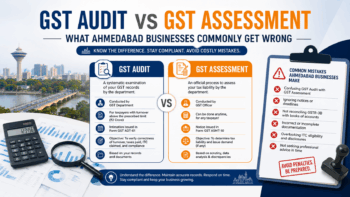
The most common mistakes businesses make include:
- ITC mismatches
- Improper reconciliation
- Ignoring GST notices
- Incorrect HSN classification
- Weak documentation practices
Proper GST compliance, reconciliation, and expert advisory support can significantly reduce litigation and penalty risks.
Why Ahmedabad Businesses Confuse GST Audit with GST Assessment
Ahmedabad has one of Gujarat’s most active business ecosystems, with manufacturers, exporters, traders, startups, and service companies handling large GST transaction volumes every month.
Despite this, many businesses still misunderstand two critical GST processes:
- GST Audit
- GST Assessment
This confusion often leads to delayed responses, incomplete documentation, and avoidable penalties.
Many companies only react after receiving:
- ASMT notices
- DRC notices
- Scrutiny communications
- ITC mismatch alerts
- E-way bill discrepancies
By then, compliance risks have already escalated.
Understanding the difference between audit and assessment is essential for protecting your business from unnecessary tax exposure.
What is GST Audit?
A GST audit is a detailed examination of:
- GST returns
- Financial statements
- Input Tax Credit (ITC)
- Tax payments
- Invoices
- Compliance records
The purpose is to verify whether the taxpayer has correctly complied with GST laws.
Purpose of GST Audit
GST authorities conduct audits to:
- Detect tax leakage
- Verify ITC claims
- Identify under-reporting
- Ensure proper tax classification
- Check reconciliation accuracy
A GST audit is primarily verification-focused.
Types of GST Audits
1. Departmental Audit
Conducted by GST officers under Section 65 of the CGST Act.
2. Special Audit
Ordered under Section 66 when authorities suspect complexity or irregularities.
3. Internal GST Review
Businesses voluntarily conduct internal reviews to identify risks before scrutiny.
Documents Reviewed During GST Audit
Authorities may examine:
- GSTR-1, GSTR-3B, GSTR-9
- Purchase and sales registers
- E-invoices
- E-way bills
- ITC reconciliation statements
- Vendor compliance records
- Expense ledgers
- Export documentation
What is GST Assessment?
GST assessment is the process through which tax authorities determine a taxpayer’s liability.
Unlike audits, assessments are determination-focused.
This usually happens when:
- Returns are not filed
- Mismatches are detected
- Data appears suspicious
- Notices are ignored
- Authorities suspect tax short-payment
Types of GST Assessments
Self-Assessment
Businesses calculate and file taxes themselves.
Provisional Assessment
Used when tax rates or valuation are uncertain.
Best Judgment Assessment
Authorities estimate liability when returns are missing or incomplete.
Summary Assessment
Used in special situations involving revenue risk.
When GST Assessment Happens
Assessment may be triggered due to:
- Large ITC claims
- Sudden turnover fluctuations
- GSTR mismatches
- Fake invoice suspicion
- Vendor non-compliance
- Repeated late filings
- E-way bill inconsistencies
Department Red Flags
Common red flags include:
- GSTR-1 and GSTR-3B mismatch
- Excess ITC claims
- Non-matching e-invoice data
- Revenue suppression indicators
- Incorrect HSN codes
- Related-party transaction irregularities
GST Audit vs GST Assessment — Key Differences
| Factor | GST Audit | GST Assessment |
|---|---|---|
| Objective | Verify compliance | Determine tax liability |
| Conducted By | GST authorities/auditors | GST assessing officers |
| Trigger | Routine selection/risk profiling | Discrepancy or non-compliance |
| Focus | Accuracy of records | Tax determination |
| Outcome | Compliance observations | Tax demand/order |
| Risk Level | Moderate | High |
Common GST Mistakes Ahmedabad Businesses Make
1. ITC Mismatch Errors
Many businesses claim ITC without:
- Vendor reconciliation
- Matching GSTR-2B
- Valid invoice verification
This is one of the biggest reasons for GST notices today.
2. Wrong Classification
Incorrect HSN/SAC classification can lead to:
- Wrong tax rates
- Short payment allegations
- Interest liabilities
- Penalties
This is especially common in:
- Manufacturing
- Chemicals
- Textile businesses
- Engineering sectors
3. E-Invoice & GSTR Reconciliation Problems
Businesses often fail to reconcile:
- E-invoice data
- Sales registers
- GSTR-1
- GSTR-3B
Even minor inconsistencies can trigger automated scrutiny.
4. Poor Documentation
Missing records create serious compliance exposure.
Examples include:
- Incomplete vendor invoices
- Missing transport proofs
- Incorrect debit/credit notes
- Unavailable purchase records
5. Ignoring GST Notices
One of the costliest mistakes is delaying notice responses.
Ignoring notices may escalate into:
- Best judgment assessment
- Demand orders
- Recovery proceedings
- Litigation
Industries in Ahmedabad Facing Higher GST Scrutiny
Ahmedabad businesses under higher scrutiny include:
- Textile manufacturers
- Export houses
- Pharma businesses
- Engineering companies
- E-commerce sellers
- IT service firms
- Real estate-related entities
Authorities closely monitor sectors with:
- High ITC utilization
- Multi-state transactions
- Export refunds
- Frequent amendments
How Businesses Can Prepare for GST Audit & Assessment
Conduct Monthly Reconciliation
Reconcile:
- GSTR-1
- GSTR-3B
- E-invoices
- Books of accounts
- GSTR-2B
Maintain Proper Documentation
Keep organized records of:
- Tax invoices
- Contracts
- E-way bills
- Vendor communications
- Payment proofs
Review Vendor Compliance
Vendor defaults can impact your ITC eligibility.
Regularly monitor:
- Return filing status
- Invoice consistency
- GST registration validity
Perform Internal GST Health Checks
Quarterly GST reviews help identify:
- Compliance gaps
- Classification issues
- ITC risks
- Process weaknesses
Step-by-Step Process to Handle GST Notices
Step 1: Identify Notice Type
Check whether it relates to:
- Scrutiny
- Assessment
- Audit
- Demand
- ITC mismatch
Step 2: Gather Supporting Records
Compile:
- Returns
- Ledgers
- Invoices
- Reconciliation statements
- Vendor confirmations
Step 3: Respond Within Timeline
Late responses can worsen the situation.
Always respond within prescribed deadlines.
Step 4: Seek Professional Representation
Complex GST matters require expert advisory support to:
- Draft responses
- Interpret legal provisions
- Reduce penalty exposure
- Handle departmental communication
Why Professional GST Advisory Matters
GST compliance has become increasingly technology-driven and data-centric.
Today, authorities use:
- AI-based scrutiny systems
- Automated reconciliation tools
- E-invoice matching
- Data analytics
Even small errors can trigger investigations.
Professional GST advisors help businesses:
- Prevent notices
- Improve compliance systems
- Handle litigation
- Optimize documentation
- Reduce operational tax risks
Mistry & Shah provides GST advisory, compliance, audit support, tax litigation assistance, and risk-focused financial consulting services for businesses across Ahmedabad and Gujarat. Their expertise spans indirect taxation, audit & assurance, international tax compliance, and regulatory advisory.
Conclusion
GST audit and GST assessment are not interchangeable terms.
An audit verifies compliance. An assessment determines liability.
Businesses that fail to understand this distinction often expose themselves to:
- Penalties
- Litigation
- ITC reversals
- Cash flow disruption
- Departmental scrutiny
For Ahmedabad businesses operating in highly regulated sectors, proactive GST compliance is no longer optional.
The right advisory support, internal controls, and documentation systems can significantly reduce GST risks while improving operational confidence.
Businesses looking to strengthen GST compliance frameworks and handle assessments efficiently should work with experienced GST professionals before issues escalate.
FAQ SECTION
What is the main difference between GST audit and GST assessment?
A GST audit checks whether your GST compliance and records are accurate, while GST assessment determines tax liability when discrepancies or non-compliance are identified.
Can GST assessment happen without an audit?
Yes. GST authorities can initiate assessment proceedings based on return mismatches, non-filing, or suspicious transactions without conducting a formal audit.
What triggers GST scrutiny?
Common triggers include ITC mismatches, incorrect tax rates, GSTR inconsistencies, delayed filings, abnormal turnover patterns, and e-invoice discrepancies.
How long should GST records be maintained?
Businesses should generally maintain GST records for at least 72 months from the due date of annual return filing.
What documents are required during GST audit?
Authorities may request invoices, ledgers, GSTR filings, e-way bills, e-invoices, reconciliation statements, contracts, and financial statements.
Can wrong HSN codes create GST liability?
Yes. Incorrect classification may result in underpayment of tax, penalties, and interest liabilities.
What should businesses do after receiving a GST notice?
Businesses should immediately review the notice, collect supporting documents, assess discrepancies, and seek professional advisory support before responding.