




TL;DR
If your business serves international markets, handles global capital, financial products, treasury operations, leasing, fintech, investment management, or cross-border structures, GIFT IFSC may offer one of India’s strongest regulatory and tax environments.
But tax incentives alone do not make the model work.
Entity selection, licensing, compliance design, operating costs, and commercial viability determine success.
What Is GIFT City (IFSC)?
GIFT City (Gujarat International Finance Tec-City) is India’s international financial and services hub built to attract global capital, international business, and regulated cross-border activity. It operates under a dedicated regulator — IFSCA — instead of multiple domestic regulators. GIFT City International Financial Services Centres Authority
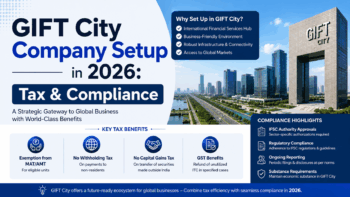
Growth has accelerated rapidly:
- Banking assets crossed $106B
- 37 banks operating
- Registered entities approaching 1,000+ scale milestones
This is no longer an experimental zone.
Why Businesses Are Moving to GIFT IFSC
Decision drivers:
| Factor | Traditional India | GIFT IFSC |
|---|---|---|
| International transactions | Moderate friction | Optimized |
| Tax incentives | Limited | Strong |
| Global structuring | Complex | Easier |
| Regulatory architecture | Multi-regulator | Unified |
| Cross-border operations | Moderate | High |
Who Should Consider GIFT IFSC?
Best fit categories:
Financial Services
- Asset managers
- Investment vehicles
- Alternative investment funds
- Broker dealers
Corporate Structures
- Global treasury centers
- Holding entities
- Captive finance entities
Emerging Segments
- Fintech
- Aircraft leasing
- Global capability centers
- International consulting entities
Not ideal for:
- Pure domestic trading
- Local retail businesses
- Businesses without international revenue plans
Entity Options Available
1. Company
Suitable for scaling operations.
2. LLP
Useful for professional firms.
3. Branch Office
Common for overseas entities.
4. Fund Structures
Institutional and investment use cases.
Selection should be tax-driven and operational—not legal convenience.
Tax Benefits of GIFT City in 2026
This is usually the headline.
But tax should be viewed after commercial feasibility.
Potential incentives may include eligibility-based benefits such as:
Corporate Tax Incentives
Subject to applicable conditions and approvals.
GST Benefits
Specific IFSC transactions may receive favorable treatment.
Capital Market Advantages
Designed for international financial activities.
International Structuring Benefits
Cross-border efficiency opportunities.
Tax treatment depends heavily on:
- Activity class
- Entity structure
- Revenue source
- Licensing position
- Transfer pricing
A wrong structure can destroy the expected savings.
Step-by-Step Company Setup Process
Step 1 — Evaluate Eligibility
Questions:
- Is activity permitted?
- Does it require licensing?
- Are minimum capital norms triggered?
Step 2 — Select Entity Structure
Evaluate:
| Criteria | Company | LLP |
|---|---|---|
| Fundraising | Strong | Moderate |
| Governance | Strong | Moderate |
| Compliance | Higher | Lower |
Step 3 — Incorporation
Core documentation:
- Constitutional documents
- KYC
- Shareholding structure
- Business model
- Capital planning
Step 4 — Obtain IFSC Permissions
Certain sectors require approval before operations.
Step 5 — Establish Compliance Framework
Prepare:
- Accounting
- Audit
- Regulatory reporting
- Governance controls
Compliance Requirements Most Founders Underestimate
Compliance is where operating economics change.
Typical obligations include:
Regulatory Reporting
Annual Filings
Tax Documentation
Audit Requirements
Beneficial Ownership Controls
Substance Requirements
Recent enforcement signals indicate regulators expect genuine operating presence—not merely registration.
Hidden Costs Nobody Includes in the Calculator
Many projections fail because founders model only incorporation.
Real cost stack:
| Cost Head | Typical Impact |
|---|---|
| Incorporation | Initial |
| Licensing | Medium |
| Advisory | Medium |
| Legal | Medium |
| Audit | Recurring |
| Office Space | Recurring |
| Technology | Recurring |
| Compliance Team | Recurring |
Add contingency.
Underbudgeting by 20–35% is common in early models.
Typical Timeline
| Phase | Duration |
|---|---|
| Planning | 1–2 weeks |
| Incorporation | 2–4 weeks |
| Regulatory approvals | 3–8 weeks |
| Banking & activation | 1–3 weeks |
Total practical range:
6–12 weeks
Complex structures may extend.
7 Mistakes Companies Make
- Chasing tax only
- Choosing wrong entity
- Ignoring licensing
- Weak documentation
- No compliance budget
- No substance planning
- Delayed advisory involvement
Should You Set Up in GIFT IFSC?
GIFT IFSC rewards businesses with international intent, disciplined governance, and long-term capital planning.
The opportunity is real.
The execution determines whether incentives become an advantage—or an expensive compliance exercise.
For founders, investment platforms, global businesses, and international operators evaluating IFSC entry, early structuring decisions have disproportionate financial impact.
MISTRY & SHAH LLP’s advisory practice includes GIFT IFSC registration, tax planning, transaction advisory, risk and compliance support designed for entities entering the ecosystem.
6. FAQ SECTION
1. Is GIFT City tax free?
No. GIFT City is not universally tax-free. Eligible businesses operating inside IFSC may access specific tax incentives subject to activity type, structure, conditions, and applicable regulations. Tax planning should be done before incorporation because entity design directly affects outcomes.
2. How much does it cost to set up a company in GIFT City?
There is no single cost figure.
Actual cost depends on:
- Entity structure
- Licensing requirements
- Capital requirements
- Office and substance obligations
- Compliance complexity
- Advisory and audit scope
Most businesses underestimate recurring operating expenses.
3. Can foreign companies establish operations in GIFT IFSC?
Yes. Foreign entities may establish approved structures depending on permitted activities and regulatory requirements. Branches, subsidiaries, investment entities, and financial structures may be possible depending on business objectives.
4. How long does GIFT City company registration take?
Typical practical timelines range from 6–12 weeks, depending on approvals, documentation quality, and banking setup.
5. Who regulates GIFT City?
Operations are regulated by the International Financial Services Centres Authority (IFSCA) which functions as the unified regulator for IFSC activities.
6. Which industries benefit most from GIFT City?
High-fit sectors include:
- Financial services
- Investment management
- Treasury operations
- Leasing
- Fintech
- International consulting
- Global capability operations
7. Is GIFT City suitable for startups?
Some startups may benefit—especially fintech, cross-border, and capital-intensive businesses—but domestic-only startups may not achieve sufficient value.
8. Is GIFT City better than offshore jurisdictions?
That depends on:
- Tax residency
- Capital strategy
- Investor requirements
- Substance obligations
- Regulatory comfort
- Long-term operating model