




By Mistry & Shah LLP, Chartered Accountants | FEMA Advisory | 2 October 2026
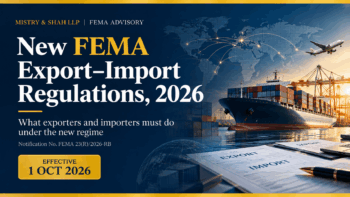
The new FEMA Service export import regulations 2026 came into force on 1 October 2026. Issued by the Reserve Bank of India as Notification No. FEMA 23(R)/2026-RB dated 13 January 2026, they bring exports and imports of goods and services, merchanting trade and related reporting into one consolidated framework. For any business with overseas customers or suppliers, the message is plain: this is not merely a regulatory update — it is a process change.
This guide explains what is changing, why the monthly EDF discipline matters for service exporters, how the role of your Authorised Dealer (AD) bank grows, and what your finance team should review now.
Quick Summary: What Is Changing from 1 October 2026
| # | Change | What it means for your business |
| 1 | One unified export–import framework | Goods, services, merchanting trade and related reporting sit in a more integrated compliance environment. |
| 2 | Monthly EDF compliance for service exporters | A disciplined, invoice-wise monthly process becomes necessary. |
| 3 | Active monitoring of realisation timelines | Each export invoice is tracked on its own, not just the total receivable balance. |
| 4 | Wider role for AD banks | Extensions, reductions, adjustments, advances, delayed payments, set-off and merchanting trade matters. |
| 5 | EDPMS, IDPMS and FETERS become central | Books, invoices, bank remittances and regulatory reporting must tell the same story. |
1. One Unified Export–Import Framework
The new regulations consolidate exports and imports of goods and services, merchanting trade and related reporting. For businesses operating internationally, this creates a more integrated compliance environment — one rulebook to read, and one process to build around.
2. Monthly EDF Compliance for Service Exporters
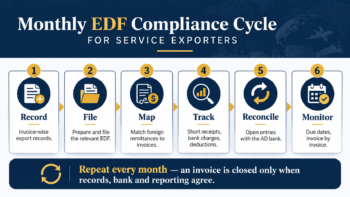
For many service businesses — IT, consulting, design, BPO and professional services — this is perhaps the most important operational change. Service exporters will need a disciplined monthly compliance process covering the steps below.
- Maintain invoice-wise export records.
- Prepare and file the relevant EDF (Export Declaration Form).
- Map foreign remittances to invoices.
- Track short receipts, bank charges and deductions.
- Reconcile open entries with the AD bank.
- Monitor due dates invoice by invoice.
3. Export Realisation Timelines Need Active Monitoring
Do not look only at the total foreign receivable balance. Each export invoice must be monitored independently — its due date, receipt status, extension requirement and closure position. In effect, receivables ageing becomes a FEMA compliance issue as well as an accounting issue.
| Old habit | New discipline |
| Review the total foreign debtor balance | Review every invoice with its own due date |
| Treat ageing as a finance-only report | Treat ageing as a FEMA compliance report |
| Chase receipts when convenient | Plan extension requirements before the due date |
| Net short receipts silently | Record short receipts, deductions and bank charges invoice-wise |
4. Authorised Dealer Banks Become Even More Important
The framework gives AD banks a wider operational role. These can include:
| Area | Where the AD bank may be involved |
| Extensions | Additional time for realisation |
| Reductions | Reduction in the amount realised |
| Adjustments and set-off | Adjusting receivables against payables |
| Advances | Advance receipts and payments |
| Delayed payments | Delayed import payments |
| Merchanting trade | Merchanting trade matters |
It is no longer enough to understand only the regulation. Businesses will increasingly need to understand how their own bank implements the regulation through its internal policy and SOP.
5. EDPMS, IDPMS and FETERS Become Central to Compliance
Cross-border transactions are increasingly connected with formal monitoring and reporting systems. Your accounting records, invoice records, bank remittances and regulatory reporting should tell the same story. A mismatch can create unnecessary follow-up, reconciliation issues and compliance exposure.
A Practical Relief: Declaration-Based Closure for Smaller Entri
es
For specified export and import transactions up to the prescribed threshold, closure may be permitted based on declaration, subject to the applicable conditions. Quarterly bulk submission can also help clear smaller outstanding entries more efficiently. Exporters with many small pending entries can use this as a reconciliation and clean-up mechanism.
The AD Bank SOP Becomes Critical
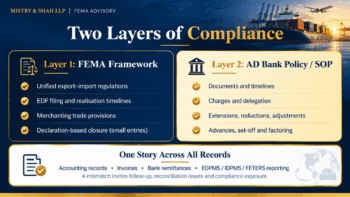
A key structural change is the greater emphasis on the written policy and SOP of AD banks. These
may deal with documents, timelines, charges, extensions, adjustments, advances, delegation and factoring. Businesses must therefore manage two layers of compliance.
What Should Businesses Do Now? A Practical Checklist
Treat this as a process change. Start by reviewing the following areas.
| Review area | Action point |
| Recording of overseas invoices | Confirm invoice-wise records with clear references |
| EDF ownership | Name the person responsible for EDF compliance |
| Remittance mapping | Map each foreign remittance to its invoice |
| Short receipts and deductions | Define how they are recorded and approved |
| Outstanding entries | Reconcile regularly with the AD bank |
| Realisation due dates | Monitor invoice-wise and set alerts |
| Escalation | Fix a route for unresolved items |
| AD bank interaction | Set a regular finance-team and bank review cadence |
Businesses that adapt their internal process early will find the transition much easier.
Frequently Asked Questions :
- When do the new FEMA export–import regulations apply?
The Foreign Exchange Management (Export and Import of Goods and Services) Regulations, 2026 came into force on 1 October 2026.
- Which notification governs the new framework?
RBI Notification No. FEMA 23(R)/2026-RB dated 13 January 2026, read with the related Directions on Export and Import of Goods and Services dated 16 January 2026 and the subsequent amendment dated 22 September 2026.
- What is the biggest change for service exporters?
A disciplined monthly EDF process — invoice-wise records, EDF filing, remittance mapping and reconciliation with the AD bank.
- Why does the AD bank’s SOP matter?
Because the framework gives AD banks a wider operational role, your bank’s written policy on documents, timelines, charges, extensions and adjustments directly affects how you comply.
- Is there any relief for small outstanding entries?
Yes. For specified transactions up to the prescribed threshold, closure may be permitted on declaration, and quarterly bulk submission is available, subject to conditions.
How Mistry & Shah LLP Can Help
Our FEMA and international taxation team assists exporters and importers with process reviews, EDF compliance workflows, AD bank coordination and reconciliation of outstanding entries. Contact us to plan your transition.
Export Smart. Stay Compliant. Grow Global.
Regulatory basis: RBI Notification No. FEMA 23(R)/2026-RB dated 13 January 2026; Directions on Export and Import of Goods and Services dated 16 January 2026; subsequent amendment dated 22 September 2026. Disclaimer: this article is for general information only and is not legal advice. Please refer to the regulations and your AD bank’s policy for your specific facts.