




TL;DR
ESOP taxation in India generally happens at two separate stages.
The first tax event occurs when an employee exercises the stock options and receives shares. The difference between the Fair Market Value (FMV) of those shares on the relevant exercise date and the exercise price paid by the employee is generally treated as a taxable perquisite under salary income.
The second tax event arises when those shares are eventually sold. The difference between the sale consideration and the cost recognised for capital-gains purposes is taxed under the applicable capital-gains provisions.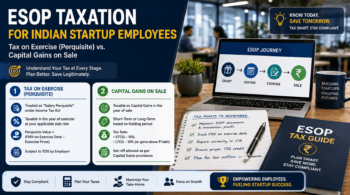
This means ESOPs are not simply “taxed twice on the same profit.” The law generally identifies two different components of economic gain:
Exercise-stage appreciation → Salary/Perquisite
Post-exercise appreciation or depreciation → Capital Gains/Loss
Employees of qualifying eligible startups may receive special relief that defers the timing of tax deduction/payment on the ESOP perquisite, but it does not generally make the ESOP gain tax-free.
How ESOPs Work Before Tax Enters the Picture
An Employee Stock Option Plan gives an employee the right to purchase company shares at a predetermined exercise price after satisfying applicable vesting conditions.
A typical ESOP journey looks like this:
Grant → Vesting → Exercise → Share Ownership → Sale
Understanding these stages is essential because taxation does not necessarily arise merely when options are granted or vested.
The two major tax points are generally:
- Exercise of the option
- Sale of the resulting shares
Confusing these stages is one of the most common reasons employees incorrectly estimate the real value of their ESOP package.
Stage 1: ESOP Tax at the Time of Exercise
When vested ESOPs are exercised, the employee pays the agreed exercise price and receives shares.
At this stage, the difference between the prescribed Fair Market Value of the shares and the amount recovered from the employee is generally treated as a taxable perquisite forming part of salary income.
The simplified calculation is:
ESOP Perquisite Value = FMV on Exercise – Exercise Price
Multiply this amount by the number of shares exercised to determine the total taxable perquisite.
ESOP Perquisite Tax Example
Assume a startup employee has:
- 5,000 vested options
- Exercise price: ₹20 per share
- Applicable FMV on exercise: ₹120 per share
The economic benefit at exercise is:
₹120 – ₹20 = ₹100 per share
For 5,000 shares:
₹100 × 5,000 = ₹5,00,000
Therefore, ₹5 lakh is generally included as the ESOP perquisite component of salary income.
The employee’s final tax impact depends on the applicable income-tax provisions, total taxable income, chosen tax regime where relevant, surcharge and cess.
Why ESOP Exercise Can Create a Cash-Flow Problem
This is especially important for employees of private startups.
Imagine exercising shares with an FMV of ₹120 even though there is currently no public market where you can immediately sell those shares.
You may have:
- Paid cash to exercise the options
- Received illiquid private-company shares
- Created taxable perquisite income
But you may not have received any cash from selling the shares.
This creates what startup employees often describe as an ESOP liquidity problem.
Your wealth may have increased on paper, but your immediate cash position may not have improved.
This is precisely why the timing of exercise should be considered as a tax and liquidity decision, not merely an administrative step in an ESOP portal.
How Fair Market Value Matters
The FMV used at exercise is critical because it determines two things:
- The taxable perquisite at exercise.
- The future cost base generally relevant when calculating capital gains.
A higher FMV may increase salary taxation at exercise, but that same value generally forms an important part of determining the cost of acquisition when the shares are subsequently sold.
This prevents the same portion of appreciation from simply being taxed again as capital gains.
Stage 2: Capital Gains When ESOP Shares Are Sold
After exercising the option, the employee owns actual shares.
When those shares are subsequently sold, a second tax calculation arises.
The simplified calculation is:
Capital Gain = Sale Consideration – Cost of Acquisition
For ESOP shares, the FMV already taken into account while calculating the exercise-stage perquisite generally becomes relevant as the cost of acquisition for capital-gains purposes under the applicable provisions.
This means only the increase in value after the exercise-stage valuation is generally captured as subsequent capital gain.
Example: Exercise Followed by Sale
Continue the previous example.
At exercise:
- Exercise price = ₹20
- FMV = ₹120
- Perquisite already calculated = ₹100 per share
Suppose the employee later sells those shares for:
₹200 per share
The capital-gain component would broadly be based on:
₹200 – ₹120 = ₹80 per share
The ₹100 appreciation between ₹20 and ₹120 was addressed as salary/perquisite at the exercise stage.
The subsequent ₹80 appreciation between ₹120 and ₹200 represents the later increase in share value that enters the capital-gains computation.
Is ESOP Taxed Twice?
This question frequently causes confusion.
Technically, ESOP transactions can create two tax events, but the same amount is not ordinarily intended to be taxed twice.
Consider the full economic journey:
| Stage | Share Value |
|---|---|
| Exercise Price | ₹20 |
| FMV at Exercise | ₹120 |
| Sale Price | ₹200 |
First Component
₹120 – ₹20 = ₹100
Taxed as an employment-related perquisite.
Second Component
₹200 – ₹120 = ₹80
Considered for capital gains taxation.
So the tax system splits the overall appreciation into two periods:
Employment benefit created up to exercise
and
Investment gain arising after exercise
What If the Share Price Falls After Exercise?
This is where ESOP taxation can become financially painful.
Suppose:
- Exercise price = ₹20
- FMV on exercise = ₹120
- Subsequent sale price = ₹80
At exercise, the employee may already have had a taxable perquisite based on the ₹100 difference.
But when the shares are subsequently sold for ₹80, they are being sold below the ₹120 cost basis generally relevant for capital gains.
That can produce a capital loss under the applicable capital-gains provisions.
The existence of a later capital loss does not automatically reverse the salary perquisite tax already triggered at exercise.
This is an important risk for employees exercising high-value private-company options.
Special ESOP Tax Deferral for Eligible Startups
The government introduced a special mechanism for employees receiving ESOPs from certain eligible startups.
This relief addresses the cash-flow difficulty of paying tax when shares are exercised even though employees may not have received liquidity from selling those shares.
However, the relief is frequently misunderstood.
Deferral Does Not Mean Exemption
The perquisite does not simply become tax-free.
Instead, the timing of the employer’s TDS/payment obligation on the ESOP perquisite can be deferred if the statutory eligibility conditions are met.
Under the current framework, the tax is required to be dealt with within the prescribed period after the earliest of specified triggering events, including broadly:
- expiry of the prescribed period from the relevant assessment year;
- sale of the ESOP shares; or
- the employee ceasing employment with the eligible startup.
Therefore, employees should not assume:
“My employer is a startup, so ESOP tax is automatically deferred.”
The company must satisfy the relevant statutory definition of an eligible startup for the special treatment to apply.
What Happens If You Leave the Startup?
For employees covered by the eligible-startup deferral mechanism, leaving the employer can become a significant tax event.
Even if the shares have not been sold, cessation of employment is one of the events relevant to determining when the deferred tax obligation becomes payable.
Employees considering resignation should therefore review:
- Number of exercised options
- Exercise-stage FMV
- Deferred ESOP perquisite
- Expected tax liability
- Liquidity available
- Whether shares can be sold
- Vesting and exercise deadlines
A resignation decision can have an ESOP cash-flow consequence that is easy to overlook.
ESOP Tax Planning: Exercise Is a Financial Decision
Before exercising a large ESOP grant, employees should ask:
What is the current FMV?
A higher valuation can increase the taxable perquisite.
How much cash is required to exercise?
The exercise price itself may require significant funds.
Will I also need cash for tax?
For employees outside the eligible-startup deferral provisions, exercise can create an immediate salary-tax impact.
Is there a liquidity event coming?
An IPO, secondary transaction or acquisition may affect how easily shares can eventually be sold.
What happens if the valuation falls?
A decline after exercise can create an economic loss while the earlier perquisite taxation may already have occurred.
How Is the Holding Period Calculated for ESOP Shares?
Once an employee exercises ESOPs and shares are allotted or transferred, the holding period becomes important because it helps determine the applicable capital-gains treatment when those shares are eventually sold.
The tax treatment depends on factors such as:
- Whether the shares are listed or unlisted
- Where the shares are listed
- Period for which the employee holds them
- Date and nature of transfer
- Whether Securities Transaction Tax (STT) conditions apply
- Whether the shares belong to an Indian or foreign company
Employees should therefore avoid assuming that every ESOP sale receives the same capital-gains treatment.
Listed vs Unlisted ESOP Shares
Startup employees commonly receive shares that are unlisted when exercised. Employees of listed companies or companies approaching an IPO may face a different situation.
| Factor | Listed Shares | Unlisted Shares |
|---|---|---|
| Liquidity | Generally higher | Usually limited |
| Market price | Readily observable | Valuation may require prescribed methodology |
| Holding-period rules | Listed-security rules may apply | Unlisted-share rules may apply |
| Sale process | Stock exchange possible | Private/secondary transaction |
| Tax calculation | Depends on applicable capital-gains provisions | Depends on unlisted-share provisions |
The distinction becomes especially important after an IPO or when employees participate in a secondary sale.
How Capital Gains Are Calculated After Exercise
Suppose an employee exercises 2,000 ESOPs.
At exercise:
- Exercise price: ₹50 per share
- FMV: ₹300 per share
- Total perquisite: (₹300 – ₹50) × 2,000
- Taxable perquisite = ₹5,00,000
Assume the employee later sells the shares for ₹450 each.
For the subsequent capital-gains calculation, the FMV already considered for the perquisite generally forms the cost of acquisition under the applicable provisions.
Therefore:
Sale Price: ₹450
Cost of Acquisition: ₹300
Capital Gain: ₹150 per share
Total:
₹150 × 2,000 = ₹3,00,000
The ₹5 lakh exercise-stage benefit and ₹3 lakh post-exercise appreciation represent different components of the employee’s economic gain.
What If ESOP Shares Are Sold Below Their Exercise-Stage FMV?
Consider:
- Exercise price: ₹50
- FMV at exercise: ₹300
- Sale price later: ₹220
The exercise-stage perquisite was:
₹300 – ₹50 = ₹250 per share
But the subsequent capital-gains computation broadly starts from the ₹300 value already considered for perquisite taxation.
Therefore:
₹220 – ₹300 = ₹80 loss per share
This may result in a capital loss, subject to the applicable provisions.
However, the earlier salary perquisite is not automatically recalculated simply because the share price subsequently fell.
That is why exercising private startup ESOPs at a very high valuation can create a substantial tax and liquidity risk.
ESOP Tax Deferral for Eligible Startups: Practical Example
The special startup provision deserves closer attention.
Under Section 192(1C), where the conditions are satisfied, tax on eligible ESOP perquisites is deducted or paid within 14 days from the earliest of the prescribed triggering events. The statutory framework includes 48 months from the end of the relevant assessment year, sale of the security, or cessation of employment.
Consider an eligible startup employee who exercises shares and creates a taxable ESOP perquisite of:
₹8,00,000
Instead of assuming that the benefit is tax-free, the employee should understand that the provision primarily changes when the related tax becomes payable/deductible.
This can provide valuable breathing room where the employee owns shares but has not yet received cash from selling them.
The Three Events Employees Need to Monitor
For qualifying cases, the deferred tax mechanism generally becomes relevant based on the earliest prescribed event.
1. Expiry of the Statutory Deferral Period
The law provides a maximum deferral linked to 48 months from the end of the relevant assessment year, subject to an earlier triggering event.
2. Sale of the Shares
If the employee sells the relevant shares before that period expires, the sale can trigger the deferred tax obligation.
3. Leaving the Employer
Cessation of employment with the eligible startup can also trigger the obligation—even where the employee continues to hold the shares.
This third situation is particularly important for employees planning a job change.
Foreign-Parent ESOPs: Why Reporting Can Become More Complex
Many Indian employees work for multinational companies or Indian startups with overseas holding companies.
Their ESOPs or RSUs may result in ownership of foreign shares.
This can introduce additional tax-reporting considerations beyond ordinary ESOP taxation.
Depending on residential status and the applicable disclosure rules, an employee may need to examine:
- Foreign share ownership
- Foreign brokerage accounts
- Overseas dividend income
- Foreign asset disclosures
- Schedule FA
- Capital gains from foreign securities
- Foreign tax credits
- Schedule FSI/TR, where applicable
An employee should not assume that information appearing in Form 16 is the only reporting obligation associated with foreign-company shares.
ESOPs, RSUs and ESPPs Are Not Necessarily Identical
Employees often use “ESOP” as a general term for every form of equity compensation.
However, companies may provide:
- Employee Stock Options (ESOPs)
- Restricted Stock Units (RSUs)
- Employee Stock Purchase Plans (ESPPs)
- Restricted shares
- Stock appreciation arrangements
The timing and mechanics of the benefit can differ.
Before calculating tax, determine exactly what type of equity compensation your employer has granted.
How to Report ESOP Income in Your ITR
Step 1: Check Form 16
Where the exercise-stage benefit has been treated as a taxable salary perquisite, review the salary and perquisite information provided by your employer.
Compare it with:
- Form 16
- Payslips
- ESOP exercise statement
- Employer tax workings
Step 2: Verify AIS and Form 26AS
Check whether the available tax information is consistent with:
- Salary reported
- TDS deducted
- Securities transactions, where reflected
- Other relevant income information
Do not automatically copy figures without reconciling them.
Step 3: Calculate Capital Gains Separately When Shares Are Sold
Once ESOP shares are sold, maintain records of:
- Exercise/allotment details
- FMV considered for perquisite purposes
- Number of shares
- Sale date
- Sale price
- Brokerage or transaction records
- Applicable expenses
- Tax documents
These details are needed to determine the correct capital-gains computation.
Step 4: Review Foreign Asset Reporting
If the ESOP relates to shares of a foreign company, determine whether additional foreign asset and foreign income schedules apply based on your residential status and other relevant conditions.
This is particularly important for employees of global technology companies and multinational startups.
Documents Every ESOP Holder Should Preserve
Keep a dedicated ESOP tax folder containing:
- ESOP grant letter
- Vesting schedule
- Exercise application
- Exercise confirmation
- Share allotment details
- FMV certificate/supporting valuation
- Employer perquisite calculation
- Form 16
- Payslips
- Brokerage statements
- Sale contract notes
- Foreign brokerage statements, where applicable
- Dividend records
- Tax payment details
These records can become extremely important years after the original exercise.
8 Common ESOP Tax Mistakes Employees Should Avoid
1. Assuming Tax Arises Only When Shares Are Sold
For conventional ESOPs, exercise itself can create a taxable salary perquisite.
Ignoring the exercise-stage liability can lead to incorrect tax planning.
2. Thinking ESOPs Are Taxed Twice on the Same Amount
The perquisite and capital-gains computations generally relate to different portions of the share’s appreciation.
3. Assuming Every Startup Gets ESOP Tax Deferral
The special deferral mechanism applies to employees of qualifying eligible startups, subject to statutory requirements. “Startup” as a general business description is not sufficient.
4. Exercising Without Calculating the Tax Impact
A large exercise can substantially increase taxable salary income.
Calculate the potential tax before exercising.
5. Ignoring the Risk of Falling Share Values
A subsequent decline in share value does not automatically undo the earlier perquisite taxation.
6. Forgetting About Tax When Resigning
For employees covered by the eligible-startup deferral mechanism, cessation of employment is a relevant triggering event.
7. Losing the Exercise-Stage FMV Records
The FMV used for perquisite taxation can be crucial when calculating the future cost of acquisition.
8. Ignoring Foreign Asset Reporting
Employees receiving shares of overseas companies should review whether Schedule FA or other international-tax disclosures apply.
ESOP Tax Planning Before an IPO
An upcoming IPO often creates excitement among employees holding options, but it also creates important tax decisions.
Before exercising purely because an IPO is expected, evaluate:
Current FMV: A high pre-IPO valuation may create a large perquisite.
Exercise Cost: How much cash is needed to acquire the shares?
Tax Cost: What is the estimated exercise-stage tax?
Lock-in Restrictions: Can you sell immediately after listing?
Liquidity: When will you realistically be able to monetize the shares?
Valuation Risk: What happens if the listing price is below expectations?
An ESOP may be extremely valuable while still creating short-term cash-flow pressure.
Conclusion
ESOP taxation in India becomes much easier to understand once employees separate the transaction into two tax stages.
At exercise, the difference between the prescribed FMV and the amount paid by the employee generally creates a taxable salary perquisite.
At sale, the subsequent movement in share value is considered under the applicable capital-gains provisions, with the value already considered for perquisite taxation playing an important role in determining the cost of acquisition.
For employees of qualifying eligible startups, special provisions can defer the timing of the exercise-stage tax obligation. But deferral should never be confused with exemption.
The biggest financial risk often arises when employees exercise valuable but illiquid shares without planning for the resulting tax liability.
Before exercising a large ESOP grant, changing jobs, participating in a secondary sale or selling shares after an IPO, calculate the complete tax and cash-flow impact—not simply the headline value of your options.
6. FAQ SECTION
1. When are ESOPs taxed in India?
ESOPs generally involve two tax events: a salary perquisite when options are exercised and capital gains when the resulting shares are subsequently sold.
2. How is ESOP perquisite value calculated?
The broad calculation is:
FMV of shares at exercise – Exercise price paid by employee = Perquisite value per share
The applicable perquisite value is generally included in salary income.
3. Is an ESOP taxed twice?
There can be two tax events, but they generally apply to different components of appreciation. The exercise-stage benefit is treated as a perquisite, while subsequent appreciation after exercise is considered for capital gains.
4. What becomes the cost of acquisition when ESOP shares are sold?
For shares acquired through a taxable ESOP exercise, the FMV taken into account for calculating the perquisite generally becomes the relevant cost of acquisition for subsequent capital-gains purposes under Section 49(2AA).
5. Can Indian startup employees defer ESOP tax?
Employees of qualifying eligible startups can receive special timing relief for TDS/payment of tax on eligible ESOP perquisites, subject to statutory conditions. The relief is a deferral, not a tax exemption.
6. What happens to deferred ESOP tax if I resign?
Cessation of employment is one of the prescribed events relevant to the eligible-startup ESOP tax deferral mechanism. Employees should therefore calculate the potential liability before changing jobs.
7. Are foreign-company ESOPs taxable for Indian employees?
They can be. Indian tax treatment depends on factors including residential status, employment income rules and subsequent sale of the shares. Foreign asset and foreign income disclosures may also apply.
8. What happens if ESOP shares fall after exercise?
A later fall in value does not automatically reverse the salary perquisite already recognised at exercise. A subsequent sale below the relevant cost of acquisition may instead create a capital loss, subject to applicable capital-gains provisions.