




TL;DR
Indian businesses are increasingly shifting toward accounting outsourcing to reduce costs, improve compliance, access expert financial support, and scale more efficiently. While in-house finance teams provide direct control, they also come with significant salary, infrastructure, training, and compliance costs. For many SMEs and startups, outsourced accounting delivers better cost efficiency, scalability, and operational flexibility.
Introduction
Finance operations are changing rapidly in India.
A decade ago, most businesses believed building an internal finance department was the only practical option. Today, that mindset is evolving.
As businesses become more digital, compliance-heavy, and cost-conscious, accounting outsourcing has emerged as a strategic growth solution rather than just a cost-saving tactic.
Indian SMEs and startups now face increasing pressure from: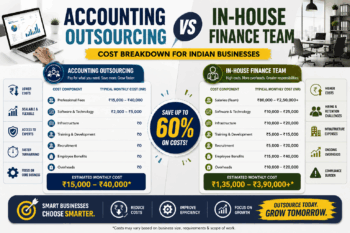
- GST compliance
- Real-time reporting
- Payroll complexities
- Investor expectations
- Cash flow management
- Operational scalability
At the same time, hiring and retaining skilled finance professionals has become more expensive.
This has led many businesses to ask an important question:
Should we build an in-house finance team or outsource accounting functions to experts?
The answer depends on cost structure, business stage, operational complexity, and growth plans.
This guide breaks down the real costs, advantages, limitations, and business implications of both models.
Why Finance Operations Are Changing in 2026
Modern finance functions are no longer limited to bookkeeping.
Businesses today expect their finance systems to provide:
- Real-time business insights
- Automated reporting
- Compliance tracking
- Cash flow forecasting
- Strategic financial guidance
Technology has transformed accounting into a highly specialized and data-driven function.
As a result:
- SMEs are adopting outsourced finance models faster
- Cloud accounting tools are replacing manual systems
- Virtual CFO services are becoming mainstream
- Automation is reducing dependency on large internal teams
Businesses now prioritize efficiency and expertise over maintaining large departments.
What is Accounting Outsourcing?
Accounting outsourcing means delegating finance and accounting functions to an external professional firm.
These services may include:
- Bookkeeping
- GST filing
- Payroll processing
- MIS reporting
- Accounts payable & receivable
- Tax compliance
- Financial reporting
- CFO advisory
Instead of hiring multiple employees internally, businesses access a specialized finance team externally.
What Does an In-House Finance Team Include?
An in-house finance department typically includes:
| Role | Responsibility |
|---|---|
| Accountant | Daily bookkeeping |
| Finance Manager | Reporting & controls |
| GST Executive | Compliance filing |
| Payroll Executive | Salary processing |
| CFO/Consultant | Strategic planning |
For growing businesses, maintaining a complete finance department becomes expensive quickly.
Real Cost Breakdown: Outsourcing vs In-House
Let’s compare estimated annual costs for a mid-sized Indian SME.
| Expense Category | In-House Team | Outsourced Accounting |
|---|---|---|
| Salaries | ₹12–25 Lakhs | Included in package |
| PF/ESI/Benefits | Additional | Not applicable |
| Office Infrastructure | ₹2–5 Lakhs | Minimal |
| Software Licenses | ₹1–3 Lakhs | Often included |
| Recruitment Costs | High | None |
| Training & Upskilling | Continuous | Managed externally |
| Compliance Expertise | Limited | Specialized experts |
| Scalability | Slower | Flexible |
| Business Continuity Risk | Higher | Lower |
Typical Observation
Many SMEs reduce finance operational costs by:
- 30% to 60%through outsourcing models.
Hidden Costs Businesses Often Ignore
The biggest mistake businesses make is comparing only salaries.
In reality, in-house finance teams involve several indirect costs.
1. Employee Turnover Costs
Replacing finance employees requires:
- Hiring
- Training
- Transition management
- Knowledge transfer
This disrupts operations significantly.
2. Compliance Risk
An inexperienced internal team may:
- Miss filing deadlines
- Make GST errors
- Create reporting inconsistencies
The resulting penalties and notices can become expensive.
3. Technology Costs
Modern accounting requires:
- ERP systems
- Cloud accounting software
- Payroll platforms
- Data backup systems
Outsourcing firms usually provide access to these systems within service fees.
4. Dependency Risk
Many SMEs depend heavily on one accountant.
If that employee resigns suddenly:
- Financial operations may stall
- Reporting delays increase
- Compliance risks rise
Outsourcing reduces dependency on single individuals.
Benefits of Accounting Outsourcing
Access to Specialized Expertise
Outsourced firms often provide:
- Chartered accountants
- Tax specialists
- Compliance experts
- Virtual CFOs
This expertise is difficult to build internally at SME budgets.
Cost Efficiency
Businesses pay only for required services instead of maintaining full-time staff.
This improves:
- Cost predictability
- Budget control
- Profitability
Better Compliance Management
Professional firms stay updated with:
- GST changes
- Income tax updates
- Payroll regulations
- MCA compliance
This reduces legal and financial risk.
Scalability
As businesses grow:
- Transaction volumes increase
- Reporting needs expand
- Compliance complexity rises
Outsourced models scale faster without major recruitment efforts.
Improved Reporting & Visibility
Modern outsourced accounting firms use:
- Cloud dashboards
- MIS reporting
- Automated reconciliations
- Financial analytics
This improves management decision-making.
Advantages of an In-House Finance Team
Outsourcing is not always the perfect solution.
In-house teams still offer advantages for certain businesses.
Direct Operational Control
Internal teams work closely with management daily.
This allows:
- Faster coordination
- Immediate communication
- Stronger operational familiarity
Industry-Specific Process Knowledge
Complex businesses with customized workflows may benefit from dedicated internal finance personnel.
Examples:
- Large manufacturing units
- Enterprises with multiple branches
- Businesses with high-volume cash operations
Sensitive Financial Handling
Some organizations prefer keeping financial operations fully internal due to confidentiality concerns.
Which Businesses Should Outsource Accounting?
Accounting outsourcing works particularly well for:
Startups
Because they need:
- Cost efficiency
- Investor reporting
- Scalability
SMEs
Because they often lack:
- Strong internal controls
- Specialized compliance expertise
Ecommerce Businesses
Due to:
- High transaction volumes
- GST complexity
- Marketplace reconciliations
Service Businesses
Because they benefit from:
- Lean operational structures
- Flexible finance support
Common Myths About Outsourced Accounting
“Outsourcing Reduces Control”
Modern cloud-based systems provide real-time access and transparency.
“Only Large Companies Outsource”
SMEs and startups are now the fastest-growing outsourcing users.
“Outsourcing Is Only About Cost Cutting”
The biggest benefits are often:
- Expertise
- Compliance
- Scalability
- Better reporting
Technology & Automation in Modern Accounting
Accounting in 2026 is heavily technology-driven.
Modern finance operations now use:
- Cloud accounting platforms
- AI-based reconciliations
- Automated invoicing
- Real-time dashboards
- Workflow automation
Outsourcing firms often adopt technology faster than internal SME teams.
This gives businesses access to enterprise-level systems without major infrastructure investment.
How to Choose the Right Accounting Model
The ideal model depends on:
- Business size
- Growth stage
- Transaction complexity
- Budget
- Industry requirements
Choose Outsourcing If:
- You want lower operational costs
- Your business is scaling rapidly
- You need compliance expertise
- You lack internal finance infrastructure
Choose In-House If:
- Operations are highly customized
- Daily finance coordination is critical
- You manage sensitive financial environments
Hybrid Model
Many businesses now use:
- Outsourced accounting
- Combined with internal finance coordinators
This hybrid model balances:
- Cost efficiency
- Control
- Expertise
How Professional Accounting Advisory Creates Long-Term Value
Professional accounting partners do more than bookkeeping.
They help businesses with:
- Financial strategy
- Compliance management
- Cash flow optimization
- Budgeting
- Risk management
- MIS reporting
- Virtual CFO support
For growing Indian businesses, outsourced finance functions increasingly act as strategic growth enablers.
Internal Linking Suggestions
- “Accounting Outsourcing Services”
- “Virtual CFO Services”
- “GST Compliance Solutions”
- “Payroll Management Services”
- “Business Financial Advisory”
Conclusion
The debate between accounting outsourcing and in-house finance teams is no longer just about cost.
It is about:
- Scalability
- Expertise
- Operational efficiency
- Compliance strength
- Business agility
For many Indian SMEs and startups, outsourced accounting provides a smarter and more scalable financial operating model.
However, the right approach depends on business complexity, operational needs, and long-term growth goals.
Businesses that build strong finance systems early gain a significant advantage in:
- Decision-making
- Investor confidence
- Compliance
- Profitability
- Sustainable scaling
As finance operations continue evolving in 2026, companies that combine technology, expert advisory, and operational efficiency will be best positioned for long-term success.
FAQ SECTION
Is accounting outsourcing cheaper than hiring employees?
Yes. Outsourcing usually reduces costs related to salaries, infrastructure, software, hiring, and training.
What are outsourced accounting services?
These services include bookkeeping, GST filing, payroll, reporting, compliance, and financial advisory handled by external professionals.
Should SMEs outsource accounting?
Many SMEs benefit from outsourcing due to lower costs, compliance expertise, and improved scalability.
How much does an in-house accountant cost in India?
Costs vary by experience and location, but maintaining a finance team often involves significant salary and operational expenses.
Is outsourced accounting safe?
Yes. Reputable firms use secure cloud systems, compliance protocols, and confidentiality agreements.
Can outsourced accounting improve reporting?
Modern outsourcing firms provide automated dashboards, MIS reports, and real-time financial visibility.
What industries benefit most from accounting outsourcing?
Startups, ecommerce companies, service businesses, SMEs, and rapidly growing businesses benefit significantly.
What is a hybrid finance model?
A hybrid model combines outsourced accounting support with an internal finance coordinator or manager.