




Introduction
India’s software and digital services exports have long been subject to the SOFTEX compliance mechanism. Originally introduced to monitor foreign exchange realisation of intangible exports, SOFTEX gradually evolved into a parallel compliance layer that operated alongside GST reporting, banking documentation, and SEZ/STPI filings.
With the notification of the Foreign Exchange Management (Export and Import of Goods and Services) Regulations, 2026, the Reserve Bank of India has replaced the SOFTEX regime with a unified Export Declaration Form (EDF) system effective 1 October 2026.
This reform integrates software and services exports into the mainstream export declaration framework under FEMA, significantly rationalising compliance architecture. The discussion below is based on the official framework outlined in the industry communication and expanded with regulatory analysis and implementation considerations.
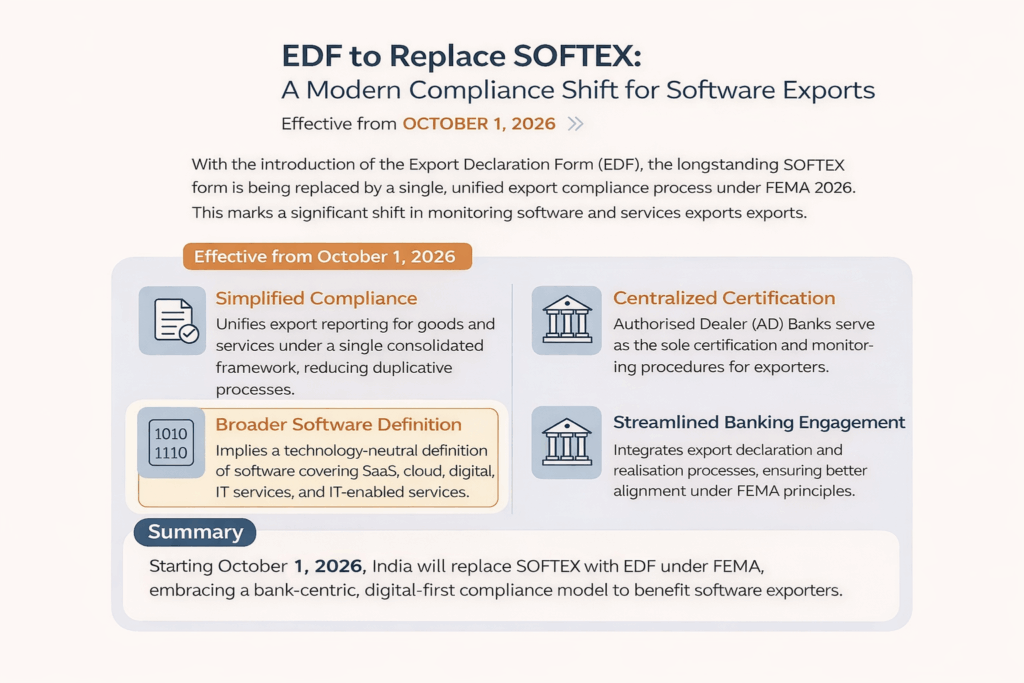
1. The Earlier SOFTEX Regime | Structure and Challenges
Under the earlier framework, software exporters were required to obtain certification for each export transaction even though foreign exchange realisation was already tracked through Authorised Dealer (AD) Banks.
Compliance Flow Under SOFTEX
| Particulars | DTA Units | SEZ Units | Monitoring Authority |
| Export Declaration | SOFTEX filed with STPI | SOFTEX filed with Development Commissioner | STPI / DC |
| Foreign Exchange Realisation | Reported to AD Bank | Reported to AD Bank | AD Bank |
| Periodic Returns | Not applicable in most cases | Monthly / Quarterly / Annual reports | SEZ Authority |
| GST Reporting | Through GST Portal | Through GST Portal | GST Authorities |
Key Structural Issues
| Issue | Practical Impact |
| Dual reporting (STPI/DC + Bank) | Duplication of documentation |
| Separate sectoral regime | Fragmented compliance structure |
| Manual certification elements | Delays in approval |
| Multiple reporting timelines | Increased administrative burden |
| Misalignment with digital GST system | Redundant compliance layers |
2. The Regulatory Reform: Introduction of Export Declaration Form (EDF)
Effective Date: 1 October 2026
Under FEMA 2026 Regulations:
- SOFTEX filing is discontinued.
- A single Export Declaration Form (EDF) applies to exports of goods and services.
- Authorised Dealer (AD) Banks become central certification authorities in most cases.
3. Legal Foundation Under FEMA 2026
| Legal Instrument | Role |
| FEMA, 1999 | Governs foreign exchange transactions |
| Export & Import of Goods and Services Regulations, 2026 | Prescribes export declaration framework |
| AD Bank Guidelines | Monitor realisation and reporting |
| RBI Supervision | Regulatory oversight |
Under FEMA principles:
- Export declaration is mandatory.
- Export proceeds must be realised within prescribed timelines.
- AD Banks monitor compliance and reporting.
The EDF reform brings software exports under this unified architecture.
4. Definition of “Software” Under FEMA 2026
“Any computer programme, database, drawing, design, audio/video signals, any information by whatever name called in or on any medium other than in or on any physical medium.”
Coverage Analysis
| Category | Covered Under Definition? |
| Software Products | Yes |
| SaaS Platforms | Yes |
| Cloud Services | Yes |
| IT Services (digital delivery) | Yes |
| IT-enabled Services | Yes |
| Digital Consulting | Yes |
| Onsite physical services abroad | Possibly outside scope |
The definition is broad, technology-neutral, and eliminates earlier distinctions between software, IT services, and ITeS.
5. SOFTEX vs EDF | Comparative Overview
| Parameter | SOFTEX Regime | EDF Regime |
| Governing Framework | Sector-specific | Unified FEMA framework |
| Filing Authority | STPI / DC | AD Bank (primarily) |
| Mandatory Certification | Yes | Optional in many cases |
| Duplication | High | Substantially reduced |
| Digital Integration | Limited | Banking-led integration |
| Ease of Doing Business | Moderate | Significantly improved |
| Applicability to Services | Limited categories | All services covered |
6. Certification Authority Matrix (Post 1 October 2026)
| Sl. No | Export Category | Nature of Export | Location | Certifying Authority | Remarks |
| 1 | Software / Digital Services | Software, SaaS, Cloud, IT/ITES | DTA | AD Bank or STPI | STPI certification optional |
| 2 | Software / Digital Services | Software, SaaS, Cloud, IT/ITES | SEZ | AD Bank or DC (SEZ) | DC certification optional |
| 3 | Non-Software Services | Consulting, Engineering, Professional | DTA | AD Bank | EDF mandatory |
| 4 | Non-Software Services | Consulting, Engineering, Professional | SEZ | DC (SEZ) | Continues through SEZ framework |
| 5 | Goods | Physical exports | DTA | Commissioner of Customs | No change |
| 6 | Goods | Physical exports | SEZ | DC (SEZ) | No change |
7. Expanded Role of Authorised Dealer (AD) Banks
The reform centralises export certification through banks.
Role Transformation
| Earlier Role of AD Bank | Expanded Role Under EDF |
| Monitor realisation | Certify export declaration |
| Track remittances | Primary compliance interface |
| Submit RBI reports | Align declaration with payment |
| Issue FIRC | Integrated compliance reporting |
This creates a single regulated channel for export declaration and realisation monitoring.
8. Practical Impact on Different Exporter Categories
| Exporter Type | Impact of EDF |
| Software DTA Units | Removal of mandatory STPI certification |
| Software SEZ Units | Optional DC certification |
| Consulting Firms | Mandatory EDF filing |
| SaaS Startups | Simplified banking-led compliance |
| MSME Exporters | Reduced documentation burden |
| Goods Exporters | No change |
9. Compliance Responsibilities Under EDF
| Area | Required Action |
| AD Bank Engagement | Understand bank SOPs |
| Documentation | Align contracts, invoices, and declarations |
| Realisation Tracking | Monitor timelines under FEMA |
| GST Reconciliation | Ensure consistency with export invoices |
| Internal SOP | Update compliance manuals |
10. Transitional Considerations
The effectiveness of the reform depends on:
| Factor | Importance |
| Uniform Bank SOPs | Critical |
| Digital submission workflows | High |
| SEZ coordination clarity | Moderate |
| RBI monitoring systems | Foundational |
11. Strategic Significance of the Reform:
| Dimension | Structural Impact |
| Regulatory Philosophy | Shift toward trust-based compliance |
| Governance Model | Banking-centric monitoring |
| Ease of Doing Business | Significant enhancement |
| Digital Alignment | Fully integrated |
| Global Alignment | Comparable to advanced jurisdictions |
12. Action Plan Before 1 October 2026 for Industry:
| Timeline | Recommended Action |
| Immediate | Review FEMA 2026 provisions |
| 3–6 Months Prior | Engage with AD Bank |
| Before Effective Date | Update internal compliance SOPs |
| Post Implementation | Monitor bank certification practices |
Author’s comment:
The transition from SOFTEX to EDF is not merely procedural reform; it is a structural recalibration of India’s foreign exchange compliance system. By integrating software and services exports into the unified export declaration framework under FEMA:
- Compliance duplication is removed.
- Banks become the central compliance anchor.
- Reporting aligns with financial flows.
- Exporters benefit from reduced administrative burden.
For India’s rapidly expanding software, SaaS, and digital services ecosystem, the EDF framework represents a modern, integrated, and future-ready export governance structure.
Disclaimer: This infographic is intended for informational and educational purposes only. It provides a high-level overview of the transition from SOFTEX to the Export Declaration Form (EDF) under the Foreign Exchange Management (Export and Import of Goods and Services) Regulations, 2026. The content does not constitute legal, regulatory, or professional advice. Exporters should refer to the applicable FEMA regulations, RBI notifications, and consult their Authorised Dealer Bank or professional advisor before taking any action based on this information.