




TL;DR
The CBDT has introduced several important changes in the Income Tax Return (ITR) Forms for Assessment Year (AY) 2026–27. These updates are designed to improve transparency, strengthen compliance, simplify filing for eligible taxpayers, and capture additional financial information. Taxpayers should review the revised reporting requirements carefully before filing to avoid defective returns, notices, or refund delays.
Why the New ITR Form Changes Matter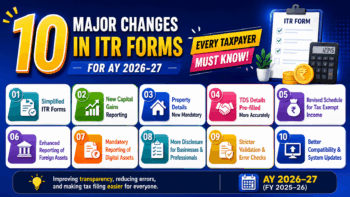
Every year, the Income Tax Department updates ITR forms to reflect amendments in tax laws, improve data accuracy, and simplify compliance.
For AY 2026–27, several significant changes affect salaried individuals, investors, professionals, traders, MSMEs, and business owners. Some changes expand eligibility for simpler forms, while others introduce additional disclosure requirements for specific transactions and deductions.
Understanding these changes before filing can help you:
- Select the correct ITR form
- Avoid defective returns
- Reduce the risk of tax notices
- Speed up refund processing
- Ensure complete and accurate disclosure
10 Major Changes in ITR Forms for AY 2026–27
1. ITR-1 (Sahaj) Now Covers Income From Two House Properties
One of the biggest taxpayer-friendly changes is the expansion of eligibility for ITR-1 (Sahaj).
Eligible taxpayers can now report income from up to two house properties, subject to the prescribed conditions, reducing the need for many salaried individuals to shift to the more detailed ITR-2.
This simplifies filing for taxpayers who own an additional residential property.
2. Expanded Capital Gains Reporting
Capital gains reporting has become more detailed in the revised ITR forms.
Taxpayers may need to provide additional information regarding:
- Nature of capital assets
- Date of transfer
- Applicable tax treatment
- Segregation under revised reporting formats
Investors should carefully review capital gains statements before filing.
3. Mandatory F&O Trading Disclosure
Individuals engaged in Futures & Options (F&O) transactions are now required to provide more detailed reporting in the relevant ITR forms.
Proper maintenance of trading statements and broker reports is essential to ensure accurate reporting.
4. Enhanced Foreign Asset Reporting
Taxpayers holding foreign assets, overseas investments, foreign bank accounts, ESOPs, RSUs, or other specified foreign financial interests should expect more comprehensive disclosure requirements.
The revised reporting framework aims to improve transparency and align with international information-sharing standards.
5. Additional Reporting for MSME Interest Payments
Businesses claiming deductions involving payments to MSMEs are required to furnish additional information in the revised forms wherever applicable.
Maintaining proper accounting records and payment documentation is increasingly important for accurate compliance.
6. Additional Validation for Deductions and Exemptions
The revised ITR forms require taxpayers to exercise greater care while claiming deductions and exemptions.
Before submitting your return, verify:
- Eligible deductions under the applicable provisions of the Income-tax Act
- Investment proofs
- Health insurance premium details
- Home loan interest certificates
- National Pension System (NPS) contributions
- Other eligible tax-saving investments
Taxpayers should ensure that every deduction claimed is supported by proper documentation and accurately reported.
7. Revised Reporting for Business and Professional Income
Businesses and professionals filing returns under the applicable ITR forms should pay closer attention to financial disclosures.
The revised forms place greater emphasis on accurate reporting of:
- Gross receipts
- Business expenses
- Profit calculations
- Depreciation
- Presumptive taxation details (where applicable)
- Balance Sheet and Profit & Loss information, if required
Maintaining updated books of account throughout the financial year can significantly simplify the filing process.
8. Updated Donation Reporting Requirements
Taxpayers claiming deductions for eligible donations should ensure that all required information is correctly reported.
Depending on the applicable provisions, details may include:
- Name of the eligible institution
- Registration or approval details
- Amount donated
- Mode of payment
Proper documentation is essential to support deduction claims during assessment, if required.
9. Additional Information for Partners in Partnership Firms
Individuals who are partners in partnership firms may be required to provide more detailed information relating to:
- Partnership income
- Remuneration
- Interest received
- Share of profit
- Firm details
Partners should reconcile the information reported in their return with the records maintained by the partnership firm to avoid inconsistencies.
10. Improved Pre-filled Data and Validation Checks
The Income Tax Department has continued to improve pre-filled information in the ITR forms.
Data may be automatically populated from various sources, including:
- TDS statements
- Salary information
- Interest income
- Dividend details
- Tax payments
- Certain financial transactions
Although pre-filled data simplifies filing, taxpayers should carefully verify every entry before submission.
Incorrect or incomplete pre-filled information should be reviewed and corrected wherever necessary.
Common Mistakes to Avoid While Filing the Revised ITR Forms
Ignoring New Disclosure Requirements
Many taxpayers continue filing returns using old practices without reviewing the revised reporting requirements.
Always read the latest instructions applicable to your ITR form.
Depending Only on Pre-filled Information
Pre-filled data is helpful but should never replace your own verification.
Compare your records with:
- AIS
- Form 26AS
- Form 16
- Bank statements
- Investment statements
Choosing the Wrong ITR Form
Selecting an incorrect form may result in your return being treated as defective or requiring corrective action.
If your income includes multiple sources, consult a tax professional before filing.
Not Reconciling Income
Ensure every source of income is properly disclosed, including:
- Salary
- Interest
- Dividends
- Capital gains
- Rental income
- Freelance or professional income
- Business income
Complete disclosure helps reduce the likelihood of future notices.
Filing Without Reviewing the Return
Before submission, perform a final review of:
- Personal information
- PAN
- Aadhaar details
- Bank account information
- Income figures
- Deductions
- Tax calculations
- Verification status
A careful review can prevent avoidable filing errors.
Quick Checklist Before Filing Your ITR
✔ Review the latest ITR form applicable to your income
✔ Verify AIS and Form 26AS
✔ Check all pre-filled information
✔ Report every source of income
✔ Verify deductions and exemptions
✔ Review capital gains reporting
✔ Maintain supporting documents
✔ Confirm bank account details
✔ Calculate tax liability accurately
✔ Verify the return after submission
Conclusion
The revised ITR Forms for AY 2026–27 introduce several important updates that taxpayers should understand before filing their Income Tax Return.
From expanded eligibility for simpler forms to additional reporting requirements for capital gains, business income, MSME payments, foreign assets, and partnership information, these changes reinforce the importance of accurate financial reporting.
Reviewing the updated forms carefully and maintaining complete documentation can help taxpayers file confidently, avoid compliance issues, and reduce the chances of notices or refund delays.
Keeping up with annual changes in Income Tax Return forms can be challenging, especially when your financial situation involves multiple income sources or complex transactions.
6. FAQ SECTION
1. What are the biggest changes in the ITR Forms for AY 2026–27?
Answer: The revised ITR forms include changes such as expanded eligibility for ITR-1 in certain cases, updated reporting for capital gains, enhanced disclosure requirements, improved pre-filled data, and additional compliance-related reporting.
2. Should I rely only on the pre-filled information in my ITR?
Answer: Compare the pre-filled details with your own financial records, AIS, Form 26AS, Form 16, bank statements, and investment documents before submitting the return.
3. Why is choosing the correct ITR form important?
Answer: The correct form depends on your sources of income, residential status, and other eligibility conditions. Using the appropriate form helps ensure accurate filing.
4. Do the revised ITR forms affect salaried employees?
Answer: Even if the filing process appears similar, updated reporting requirements may affect how certain information is disclosed.
5. How do the new changes affect business owners?
Answer: Maintaining proper books of account and accurate financial records throughout the year can make compliance easier.
6. Can a Chartered Accountant help with the revised ITR forms?
Answer: A Chartered Accountant can review your financial information, identify reporting requirements relevant to your case, and help prepare your return in accordance with the latest ITR forms.
7. What should taxpayers do before filing under the revised ITR forms?
Answer: Verify income, deductions, tax payments, disclosures, bank details, and supporting documents, and complete return verification after filing to ensure the process is successfully completed.