




TL;DR
Income Tax Audit and Statutory Audit are two different compliance requirements followed by businesses in India.
An Income Tax Audit focuses on verifying whether financial records comply with Income Tax Act requirements, while a Statutory Audit examines financial statements according to applicable laws and regulations.
Understanding the difference helps business owners complete the right compliance processes, avoid penalties, and maintain accurate financial reporting.
Why Businesses Need Audits
Audits play an important role in maintaining transparency, accuracy, and compliance in business operations.
As businesses grow, financial transactions become more complex. Proper audits help identify:
- Accounting errors
- Compliance gaps
- Financial irregularities
 Reporting mistakes
- Tax risks
Audits also improve confidence among:
- Investors
- Banks
- Stakeholders
- Government authorities
For business owners, audits are not just regulatory requirements—they are tools for better financial management.
What is an Income Tax Audit?
An Income Tax Audit is conducted under the provisions of the Income Tax Act to verify the accuracy of income, expenses, deductions, and financial information reported by a taxpayer.
The objective is to ensure that:
- Books of accounts are properly maintained
- Income is accurately reported
- Expenses are correctly recorded
- Tax compliance requirements are followed
The audit report is submitted in the prescribed format by a Chartered Accountant.
Purpose of Income Tax Audit
The main objectives of a tax audit include:
Ensuring Correct Tax Reporting
A tax audit verifies whether the taxpayer has correctly calculated taxable income and tax liability.
Preventing Errors
It identifies:
- Incorrect deductions
- Unsupported expenses
- Accounting inconsistencies
Improving Compliance
It ensures businesses follow accounting and reporting requirements under tax laws.
Income Tax Audit Applicability
Income Tax Audit applicability depends on factors such as:
- Business turnover
- Profession receipts
- Prescribed thresholds
- Tax provisions applicable to the taxpayer
Businesses and professionals should evaluate their eligibility requirements every financial year.
Income Tax Audit Process
The general process includes:
Step 1: Review Books of Accounts
The auditor examines:
- Sales records
- Purchase records
- Expenses
- Bank statements
- Supporting documents
Step 2: Verify Financial Information
The auditor checks whether:
- Income is correctly recorded
- Expenses are genuine
- Transactions are properly classified
Step 3: Prepare Audit Report
After verification, the Chartered Accountant prepares the required audit report and submits details as per applicable requirements.
What is a Statutory Audit?
A Statutory Audit is a legally required examination of financial statements to ensure they present a true and fair view of the business’s financial position.
It is generally applicable to entities such as:
- Companies
- Certain LLPs
- Other entities where required by law
The focus is on financial reporting accuracy and compliance with applicable regulations.
Purpose of Statutory Audit
A Statutory Audit ensures that the financial statements prepared by a business accurately represent its financial position.
The main objectives include:
Verifying Financial Statements
The auditor reviews:
- Balance Sheet
- Profit & Loss Statement
- Cash Flow Statement
- Notes to accounts
to ensure accuracy and reliability.
Ensuring Legal Compliance
A statutory audit checks whether the business follows applicable laws, accounting standards, and regulatory requirements.
Improving Financial Transparency
Audited financial statements help build confidence among:
- Investors
- Banks
- Business partners
- Regulatory authorities
Statutory Audit Applicability
Statutory audit requirements depend on the legal structure and applicable laws.
Common entities requiring statutory audits include:
- Private Limited Companies
- Public Companies
- Certain LLPs
- Other specified entities
The requirement is generally based on entity type rather than only turnover.
Statutory Audit Process
Step 1: Planning and Understanding Business Operations
The auditor reviews:
- Business activities
- Internal controls
- Accounting systems
- Financial processes
Step 2: Examination of Records
The auditor verifies:
- Financial transactions
- Supporting documents
- Account balances
- Compliance records
Step 3: Audit Report Preparation
After completing procedures, the auditor provides an audit opinion on the financial statements.
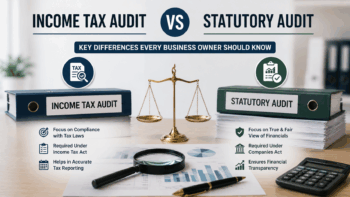
Income Tax Audit vs Statutory Audit: Comparison Table
| Factor | Income Tax Audit | Statutory Audit |
|---|---|---|
| Purpose | Verify tax compliance and reporting | Verify financial statement accuracy |
| Governed By | Income Tax Act | Applicable company/entity laws |
| Main Focus | Taxable income and deductions | True and fair financial reporting |
| Applicability | Based on tax audit conditions | Based on entity structure and legal requirements |
| Conducted By | Chartered Accountant | Chartered Accountant |
| Main Output | Tax Audit Report | Audit Report on Financial Statements |
| Objective | Ensure correct tax reporting | Ensure reliable financial statements |
Key Differences Between Income Tax Audit and Statutory Audit
1. Difference in Objective
The biggest difference is the purpose.
Income Tax Audit focuses on ensuring compliance with income tax provisions.
Statutory Audit focuses on verifying whether financial statements accurately represent business performance.
2. Difference in Applicability
Tax audit requirements depend mainly on business activity, turnover, and tax rules.
Statutory audit requirements depend mainly on the legal structure of the business.
For example:
- A company may require statutory audit regardless of turnover.
- A small business may require tax audit only after crossing prescribed conditions.
3. Difference in Reporting
Income Tax Audit reports contain information required by tax authorities.
Statutory Audit reports provide an auditor’s opinion on financial statements.
4. Difference in Compliance Purpose
Tax audit helps ensure proper tax calculation and reporting.
Statutory audit improves financial transparency and corporate governance.
Common Audit Mistakes Businesses Make
Poor Record Maintenance
Incomplete records can make audits difficult and increase compliance risks.
Maintain:
- Proper invoices
- Expense documents
- Bank records
- Agreements
- Accounting entries
Ignoring Reconciliation
Businesses should regularly reconcile:
- Bank accounts
- GST records
- Vendor balances
- Customer receivables
Last-Minute Preparation
Waiting until audit deadlines can lead to:
- Missing documents
- Errors
- Delays
- Compliance issues
Incorrect Expense Classification
Wrong accounting treatment can affect:
- Profit calculation
- Tax liability
- Financial reporting
Lack of Internal Controls
Businesses should establish processes for:
- Approval of expenses
- Payment verification
- Record maintenance
- Financial reviews
How a Chartered Accountant Helps With Audits
A Chartered Accountant supports businesses by:
- Maintaining proper accounting systems
- Reviewing financial records
- Identifying compliance gaps
- Preparing audit documentation
- Ensuring timely filings
- Providing tax and financial guidance
Professional audit support helps businesses reduce risks and maintain financial discipline.
Audit Preparation Checklist for Businesses
| Activity | Status |
|---|---|
| Maintain updated books of accounts | ☐ |
| Organize invoices and documents | ☐ |
| Reconcile bank statements | ☐ |
| Verify GST records | ☐ |
| Review expenses | ☐ |
| Prepare financial statements | ☐ |
| Maintain compliance records | ☐ |
| Coordinate with auditor | ☐ |
Conclusion
Income Tax Audit and Statutory Audit serve different purposes, but both play an important role in maintaining business compliance and financial transparency.
Income Tax Audit focuses on accurate tax reporting, while Statutory Audit focuses on verifying financial statements and legal compliance.
Understanding these differences helps business owners prepare better, avoid compliance issues, and make informed financial decisions.
A proactive audit approach strengthens financial management and creates confidence among stakeholders.
6. FAQ SECTION (AEO Optimized)
1. Is income tax audit and statutory audit the same?
Short Answer: No, they are different types of audits with different purposes.
2. Who is required to undergo income tax audit?
Short Answer: Businesses and professionals meeting prescribed conditions may require tax audit.
3. Who needs statutory audit in India?
Short Answer: Certain entities such as companies generally require statutory audit.
4. Can one Chartered Accountant conduct both audits?
Short Answer: Yes, a Chartered Accountant may conduct both where permitted.
5. Why is audit important for businesses?
Short Answer: Audits improve accuracy, compliance, and financial transparency.
6. What happens if a business does not complete required audits?
Short Answer: Non-compliance can result in penalties and regulatory issues.
7. When should businesses prepare for audits?
Short Answer: Businesses should maintain audit readiness throughout the year.