




TL;DR
GST return filing mistakes are one of the most common reasons businesses receive notices, experience delays in refunds, or face increased departmental scrutiny.
Errors such as incorrect Input Tax Credit (ITC) claims, mismatch between GST returns and accounting records, inaccurate invoice reporting, and delayed filings can create compliance risks.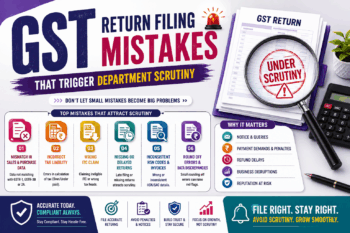
A structured GST reconciliation process and timely review by professionals can help businesses avoid unnecessary disputes and maintain smooth tax compliance.
Why GST Return Accuracy Matters for Businesses
Goods and Services Tax (GST) has simplified indirect taxation in India, but it has also introduced a strong digital compliance system.
Every transaction reported under GST leaves a digital trail through:
- Tax invoices
- GST returns
- E-way bills
- Input Tax Credit records
- Supplier filings
- Payment records
Because GST systems are interconnected, even small reporting errors can create mismatches that may attract attention from tax authorities.
For businesses, accurate GST filing is not only about avoiding penalties—it also helps maintain:
- Smooth ITC flow
- Faster refunds
- Better financial records
- Reduced compliance risks
- Stronger credibility during audits
Common GST Return Filing Mistakes That Trigger Scrutiny
1. Mismatch Between GSTR-1 and GSTR-3B
One of the most common GST compliance issues is inconsistency between outward supply details reported in GSTR-1 and tax liability declared in GSTR-3B.
Example:
A business reports higher sales in GSTR-1 but declares lower tax liability in GSTR-3B.
Such differences may raise questions because:
- Sales reported do not match tax payment.
- Buyers’ ITC claims may not align.
- Revenue reporting appears inconsistent.
Businesses should reconcile:
- Sales invoices
- GSTR-1 data
- GSTR-3B liability
- Accounting records
before filing returns.
2. Incorrect Input Tax Credit (ITC) Claims
Input Tax Credit is one of the biggest areas monitored under GST.
Businesses often face issues due to:
- Claiming ITC without valid invoices
- Claiming blocked credits
- Taking credit before eligibility
- Difference between purchase records and GST data
- Missing supplier compliance checks
Incorrect ITC claims can result in:
- Reversal of credit
- Interest liability
- Penalties
- Department notices
Before claiming ITC, businesses should verify:
- Invoice availability
- Supplier GST compliance
- Eligibility under GST provisions
- Matching purchase records
3. Failure to Reconcile Purchase Records
Many businesses file GST returns without comparing their accounting software data with GST portal records.
Regular reconciliation helps identify:
- Missing purchase invoices
- Duplicate entries
- Incorrect GSTIN details
- Wrong tax amounts
- Vendor filing issues
A monthly GST reconciliation process can prevent larger compliance problems later.
4. Incorrect HSN/SAC Code Reporting
HSN codes for goods and SAC codes for services help classify transactions under GST.
Incorrect reporting may create issues such as:
- Wrong tax rate application
- Reporting inconsistencies
- Clarification requirements
- Compliance alerts
Businesses should regularly review:
- Product classification
- Service classification
- Applicable GST rates
- Invoice accuracy
Correct classification improves transparency and reduces scrutiny risk.
5. Late GST Return Filing
Missing GST filing deadlines is one of the most common compliance mistakes businesses make.
Late filing can result in:
- Late fees
- Interest liability
- Blockage of compliance efficiency
- Difficulty in maintaining accurate tax records
- Increased chances of scrutiny
Even if there are no sales transactions during a period, businesses registered under GST may still need to file applicable returns.
Maintaining a GST compliance calendar helps businesses avoid unnecessary penalties and last-minute errors.
6. Incorrect HSN and SAC Code Reporting
HSN (Harmonized System of Nomenclature) and SAC (Services Accounting Code) classification plays an important role in GST reporting.
Incorrect classification may lead to:
- Wrong GST rate application
- Tax payment differences
- Return mismatches
- Department queries
Businesses should regularly review:
- Product/service classification
- Applicable GST rates
- Invoice descriptions
- Changes in tax regulations
Accurate classification improves transparency and reduces compliance risks.
7. Difference Between Accounting Books and GST Returns
Your books of accounts and GST returns should reflect consistent information.
Common mismatches include:
- Sales appearing in books but missing in returns
- Expenses recorded without GST details
- Incorrect purchase entries
- Difference in turnover figures
Regular reconciliation between:
- Accounting software
- Sales register
- Purchase register
- GST portal data
helps identify issues before they become compliance concerns.
8. Claiming ITC Without Verifying Supplier Compliance
A business may claim Input Tax Credit only when required conditions are fulfilled.
Problems can arise when suppliers:
- Do not file GST returns
- Report incorrect invoices
- Provide invalid GST details
- Fail to pay collected tax
Businesses should maintain proper vendor verification processes, especially when dealing with multiple suppliers.
A strong vendor compliance system reduces the risk of ITC disputes.
9. Incorrect Tax Classification
Businesses sometimes apply incorrect GST rates due to misunderstanding product or service classification.
Examples include:
- Treating taxable supplies as exempt
- Applying lower GST rates incorrectly
- Incorrect treatment of mixed supplies
- Wrong place of supply reporting
Such errors can create tax differences and attract departmental attention.
Professional GST review can help businesses identify classification risks before filing returns.
10. Ignoring GST Notices or Communications
Receiving a GST notice does not always mean a business has committed wrongdoing. However, ignoring official communication can create bigger problems.
Businesses should:
- Review notices carefully
- Understand the reason
- Prepare supporting documents
- Respond within deadlines
- Seek professional guidance where required
Timely responses demonstrate compliance responsibility and reduce escalation risks.
How Businesses Can Avoid GST Department Scrutiny
A strong GST compliance system focuses on prevention rather than correction.
Businesses should:
Maintain Accurate Accounting Records
Keep updated records of:
- Sales invoices
- Purchase invoices
- Expense documents
- Tax payments
- Credit notes
- Debit notes
Perform Monthly GST Reconciliation
Regular reconciliation helps identify:
- Invoice mismatches
- ITC differences
- Filing errors
- Supplier issues
Review Returns Before Filing
Before submitting GST returns, verify:
- Tax liability
- Input Tax Credit
- Turnover details
- Invoice information
- Previous period adjustments
Maintain Proper Documentation
Keep records of:
- Purchase agreements
- Invoices
- Payment proofs
- GST filings
- Reconciliation reports
Documentation becomes extremely valuable during audits or departmental queries.
GST Return Filing Compliance Checklist
| Activity | Status |
|---|---|
| Verify sales invoices | ☐ |
| Check purchase invoices | ☐ |
| Reconcile Input Tax Credit | ☐ |
| Match GSTR-1 and GSTR-3B | ☐ |
| Verify GST payments | ☐ |
| Check HSN/SAC details | ☐ |
| Review amendments | ☐ |
| Maintain supporting documents | ☐ |
| File returns before deadlines | ☐ |
| Review GST notices regularly | ☐ |
Why Professional GST Compliance Support Matters
GST compliance involves continuous monitoring, reconciliation, and reporting.
As businesses grow, handling GST internally can become challenging due to:
- Increased transactions
- Multiple vendors
- Complex tax classifications
- Changing regulations
- Higher compliance expectations
Professional GST support helps businesses:
- Ensure accurate return filing
- Identify compliance risks
- Improve ITC management
- Handle GST notices
- Maintain proper records
- Reduce penalty exposure
A proactive GST approach allows business owners to focus on growth while maintaining regulatory confidence.
Conclusion
GST return filing is not just a monthly or quarterly formality—it is a critical part of maintaining a financially healthy and compliant business.
Mistakes in ITC claims, invoice reporting, reconciliation, tax classification, and return filing can create unnecessary scrutiny and financial risks.
Businesses that adopt proper accounting practices, regular reconciliation, and professional GST reviews can significantly reduce compliance issues.
The best time to fix GST mistakes is before they become notices.
6. FAQ SECTION
1. What GST mistakes can trigger department scrutiny?
Answer: Incorrect ITC claims, return mismatches, wrong invoice details, and inaccurate reporting can trigger GST scrutiny.
2. Why do businesses receive GST notices?
Answer: GST notices are usually issued due to discrepancies, missing information, or compliance concerns.
3. How can businesses avoid GST penalties?
Answer: Regular reconciliation, timely filing, accurate documentation, and professional reviews help avoid penalties.
4. Can incorrect ITC claims create GST problems?
Answer: Yes, incorrect ITC claims can result in credit reversal, interest, and penalties.
5. What should businesses check before filing GST returns?
Answer: Businesses should verify invoices, tax liability, ITC, and reconciliation reports before filing.
6. How often should GST reconciliation be done?
Answer: GST reconciliation should ideally be performed monthly.
7. Can GST filing mistakes be corrected?
Answer: Yes, many GST errors can be corrected through available amendment and correction mechanisms.
8. Do small businesses need GST compliance support?
Answer: Yes, especially as transaction volume increases.